When a will reads nothing like the person you knew, the first feeling is rarely greed. It is the sense that something happened in the last months of a parent’s life that nobody talked about openly. Maybe a sibling moved in and took over every appointment. Maybe a new caregiver ended up with the house.
You are not trying to start a fight. You want to know whether what is written down reflects what your loved one wanted.
Contesting a will is time-sensitive, and the window in Missouri and Arkansas is shorter than most people expect. To challenge a will, you need three things: legal standing, a recognized legal ground, and a petition filed before the deadline runs. Miss any one of them and the probate court will not hear the case, no matter how strong it feels.
Over the years I have walked families in Joplin, Springfield, and Bentonville through this. Here is how it works, and where people most often go wrong.
You need legal standing before you can contest a will, and not everyone who feels wronged qualifies.
Courts recognize a specific set of grounds: lack of testamentary capacity, undue influence, fraud or forgery, and improper execution.
Missouri generally gives you six months to contest a will. Arkansas can give you as little as three months after notice is published.
A will contest is an investment. Get an honest read on the likely fees and the strength of your case before you commit.
Winning does not always erase the whole will. Courts can strike a single provision and leave the rest standing.
Mediation and negotiated settlements resolve many estate disputes without a trial, usually faster and for less.
A no-contest clause can put the inheritance you already have at risk, so get advice before you file anything.
Who Can Contest a Will
Only an “interested person” can contest a will. That means you have a direct financial stake in the estate: someone named in the will, someone left out who would otherwise have inherited, or an heir who would take property under intestate succession law if the will were set aside. Feeling wronged is not the same as having standing, and the difference catches people off guard.
In both Missouri and Arkansas, the people who clearly qualify are spouses, children, and heirs who would take a share if the will were declared invalid. Creditors of the estate can have limited standing too, because how the estate is administered affects whether they get paid. An AARP survey from April 2024 found that 51% of adults age 50 and older have a legal will, which leaves a lot of estates where it is genuinely unsettled who stands to inherit.
The table below is a general guide to who tends to have standing. It is a starting point, not a ruling. Standing is decided by the probate court based on the specific facts of your family and the will in question.
Your relationship to the person who died
Likely standing in Missouri
Likely standing in Arkansas
Spouse
Yes
Yes
Biological child
Yes
Yes
Legally adopted child
Yes
Yes
Stepchild, never legally adopted
Usually only if named in a prior will
Usually only if named in a prior will
Grandchild
Yes, if their parent has died
Yes, if their parent has died
Sibling
Usually only if there is no spouse or child
Usually only if there is no spouse or child
Creditor of the estate
Limited standing
Limited standing
Close friend
No
No
Neighbor or caregiver
No
No
The hardest conversations I have are with people who assumed they qualified and do not. A stepchild who was never legally adopted, a close friend named in an old will, or a neighbor who was promised something verbally usually has no standing under Missouri or Arkansas probate law. I would rather tell someone that before they spend money than after. Confirming standing is the first thing I look at, every time, because everything else depends on it.
The Legal Grounds That Hold Up in Court
You cannot contest a will just because it feels unfair. Courts in Missouri and Arkansas recognize a specific set of grounds, and a successful challenge has to fit one of them.
Lack of testamentary capacity
Testamentary capacity means that at the moment of signing, the person understood what they owned, who their close family was, and what the will did. Plenty of people sign valid wills while living with a serious illness. The Alzheimer’s Association reports that 7.4 million Americans age 65 and older are living with Alzheimer’s in 2026, and a diagnosis alone is not a will contest. What matters is the person’s state of mind on the day they signed, which is why medical records from around that date carry so much weight.
In my practice, a common situation looks like this: one adult child is certain a parent’s dementia diagnosis makes the will easy to overturn, while another is just as certain the parent knew exactly what they were doing. Both can be partly right. Someone can carry a hard diagnosis and still have a clear morning when they understood what they owned and who their family was. What decides a capacity case is narrower than the illness itself: it comes down to what the medical records and the witnesses show about the person’s mind on the actual day they signed. That is usually a tighter question than families expect when they walk in.
Undue influence
Undue influence is one of the most common grounds I see, and one of the hardest to prove. Courts look for a relationship of trust between the person who made the will and the person who benefited, signs of isolation, sudden changes to a long-standing plan, and a will-maker in a weakened state. The pressure is rarely dramatic. More often it looks like one family member quietly controlling every visit, every phone call, and every conversation in the final months.
A pattern I see again and again starts with one adult child or a new caregiver who moves close at the very end, takes over the appointments and the finances, and then a revised will surfaces that quietly shifts everything their way. Families rarely have a single dramatic moment to point to. What they have is a string of small changes, a parent who slowly stopped answering the phone, and a plan that held steady for years until the final months. That string is what a court actually weighs, which is why my first questions are about who had access and how isolated the person became, long before we ever reach the signature itself.
Fraud, forgery, and improper execution
Fraud happens when someone is tricked into signing a will, or misled about what it says or who it benefits. Forgery means the signature is not genuine, which is where handwriting analysis and document examiners come in. Improper execution covers wills that were not witnessed correctly or otherwise failed the signing formalities under Missouri or Arkansas law. These are technical grounds, and they often turn on details the family never knew to ask about.
A later or earlier will surfaces
A will can be revoked by a newer document or by physical destruction. If a valid later will appears after probate opens, it can replace the one being administered. If someone finds an older will they believe better reflects the person’s wishes, the path is to challenge the newer document in probate court rather than act on the old one directly.
Here is how the suspicions families bring to me usually line up with a legal ground.
What you suspect happened
Likely legal ground
Evidence that tends to matter
Your loved one did not understand what they were signing
Lack of testamentary capacity
Medical records, physician testimony, notes from the signing period
Someone pressured or manipulated the will-maker
Undue influence
Witness accounts, signs of isolation, sudden changes to the plan
The signature does not look genuine
Forgery
Document examiner, authentic signature samples
The will was not signed or witnessed properly
Improper execution
The will itself, witness affidavits, signing records
A newer or older will exists
Revocation or a superseding will
The competing document, the drafting attorney’s records
Your loved one was deceived about what they signed
A will contest is mostly paperwork, records, and waiting. The courtroom drama people picture is rare. The work happens in three phases.
First, gather evidence before filing anything. That means medical records from around the signing date, financial records showing unusual transfers, correspondence that hints at pressure, and the names of people who can speak to the will-maker’s state of mind. Filing first and gathering later is the most common mistake I see, and it weakens an otherwise strong case.
Second, file a petition with the probate court in the county where the person lived. In Missouri the matter goes through the probate division of the circuit court. In Arkansas it is filed in the county circuit court handling the estate. The clerk assigns a case number, and the contest becomes part of the public record.
Third, notify every interested party within the required window. Proper notice is a due process requirement, not a formality. Serving the wrong people, or failing to serve the right ones, can get a case dismissed before a judge ever weighs the merits.
From there the case moves through discovery, pretrial motions, and often mediation before it reaches a trial. Most of this plays out over months, sometimes longer if the local docket is backed up.
The wealth moving through this system keeps growing. Cerulli Associates projects that $124 trillion in wealth will transfer through 2048, which means probate courts will see more of these disputes, not fewer.
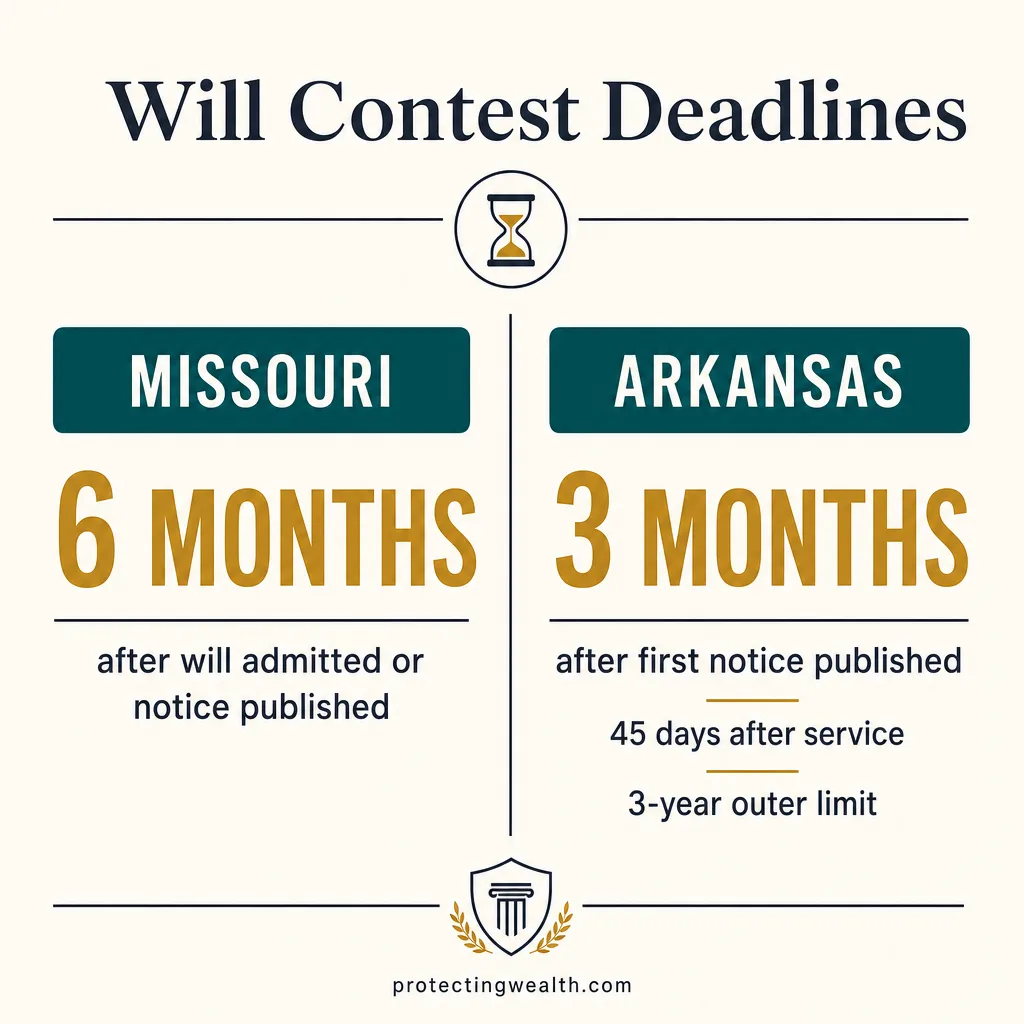
Will contest filing deadlines in Missouri and Arkansas.
The Deadlines That Can End a Case Before It Starts
Deadlines are where good cases die. Missouri and Arkansas both move faster than most families realize, and the two states are not the same.
In Missouri, you generally have six months to contest a will. Under Missouri Revised Statutes Section 473.083, the petition must be filed within six months after the will is admitted to or rejected from probate, or within six months after the first publication of notice of letters granted on the estate, whichever is later. Missouri courts treat that window seriously. Miss it and the grounds no longer matter.
Arkansas works differently, and you may have far less time. Under Arkansas Code Section 28-40-113, a contestant who was notified that the will was admitted to probate generally must file objections within three months after the first publication of that notice, or within 45 days after a copy of the notice was served, whichever is later. There is an outer limit of three years after the will is admitted to probate for situations where proper notice was not given. Because the clock can start as soon as notice is published, families who assume someone else is handling it can lose the right to contest while they are still grieving.
A pattern I see often is a family scattered across different states, each one assuming a sibling closer to home is taking care of the estate, while the clock in Arkansas runs the whole time. By the time someone finally reads the will closely and senses the numbers do not add up, the window to object has narrowed or closed. Grief slows everyone down at exactly the moment the law speeds up, and no judge can give back a deadline that has already passed. If something feels wrong, the safest move is to ask about the filing dates early, before you have even decided whether to act.
Narrow exceptions exist. A legal disability, such as a contestant who is a minor or is mentally incapacitated, can pause the deadline in some circumstances, and actively concealed fraud may extend it. Courts apply these exceptions carefully and expect real evidence, so they are never something to count on.
What It Costs and Whether It Is Worth Pursuing
A will contest is an investment, and an honest cost conversation belongs at the start. Most probate litigation is billed hourly, and the total depends on how hard the other side fights and whether expert witnesses are needed. Beyond attorney time, a contested case can carry court filing fees, the cost of obtaining medical records, deposition expenses, and fees for handwriting or capacity experts.
I tell families to look at more than the size of the estate. The strength of the evidence, the odds the other side settles, the time the case may take, and the emotional toll all matter. A will contest can make good sense when the grounds are strong and the estate is large enough to justify the cost.
It can also be the wrong move. I have told people honestly that the likely legal fees would eat up much of what they stood to gain, and that a negotiated resolution would protect more of the estate than a courtroom fight. That honest math matters more than the instinct to fight, and it is the right answer when the numbers do not work.
What Happens If You Win or Lose
Winning a will contest does not always mean the whole document disappears. When a probate court declares a will invalid, the estate does not freeze. If an earlier valid will exists, that document takes over. If none can be found, the estate passes under the intestate succession laws of Missouri or Arkansas, which distribute property to family in a fixed order rather than by anyone’s personal wishes.
Sometimes only a piece of the will falls. Courts can strike a single provision while leaving the rest intact, which matters when the challenge targets just one gift or one beneficiary. The rest of the plan can stand exactly as written while the contested portion is reworked.
When no valid will survives, both states send the estate down a structured line of succession that starts with the spouse and children. The specific shares differ between Missouri and Arkansas, especially how a spouse’s portion is calculated when there are children from outside the marriage. That is one more reason to get state-specific advice before assuming you know what you would receive.
Alternatives to a Full Court Battle
A formal will contest is not the only path, and it is often not the first one I recommend. Mediation puts a neutral third party in the room to help family members reach their own agreement instead of leaving the outcome to a judge. It usually costs less, moves faster, and gives the family more control over the result. For relatives who still have to sit across from each other at holidays, that control is worth a great deal.
In my practice, a common situation looks like siblings who agree on almost everything except one piece of family property, often land that has been in the family for generations and means more to them than its price. A full court fight over that one asset can cost more than the asset is worth and leave a rift that outlasts the case. Mediation lets the family decide how to handle it themselves, on terms a judge would never have the time to craft, and it leaves people able to sit together afterward. When the real dispute is about meaning more than money, that room to talk matters.
Negotiated settlements resolve many of these disputes before trial. A settlement offer backed by real evidence can produce a faster, more predictable outcome than handing the decision to a court.
A quieter option has nothing to do with the will’s validity. If the person who died owed you money, filing a creditor claim against the estate can recover what is owed without contesting the will at all. That route can make sense when the grounds for a challenge are weak but a legitimate debt clearly exists.
No-Contest Clauses and the Risk of Losing What You Already Have
Some wills contain a no-contest clause, also called an in terrorem clause. It says that a beneficiary who challenges the will and loses forfeits whatever they were left. These clauses exist to discourage challenges, and they can carry real teeth, so anyone named in a will with one should get advice before filing anything.
Missouri and Arkansas handle them differently. In Missouri, no-contest clauses are generally enforceable, but courts construe them strictly because the law disfavors forfeitures. Missouri also gives beneficiaries a built-in safeguard. Under Missouri Revised Statutes Section 474.395, an interested person can petition the court ahead of time for a determination of whether a particular filing would actually trigger the clause, before risking the inheritance.
Arkansas courts also enforce these clauses, but they weigh the circumstances of the challenge, including whether the contest was brought in good faith. The takeaway is the same in both states. If your inheritance is on the line, find out where you stand before you file.
A no-contest clause only has leverage over someone who was left something. If you received nothing under the will, the clause has nothing to take from you. These provisions generally do not reach actions outside a formal will contest either, such as a creditor claim or a request for an accounting of how the estate is being handled.
How Our Firm Helps Missouri and Arkansas Families
Since 1997, I have helped families across Missouri and Arkansas work through some of the hardest moments an estate can bring. Will contests, undue influence claims, and capacity disputes are not new territory for our firm, and families deserve a clear-eyed read on whether a challenge makes sense before they commit.
Teaching is part of how I practice. I am an adjunct professor at Missouri Southern State University, and the same instinct shows up in how I work with families: explain the process in plain language, give an honest assessment of the grounds and the deadlines, and make sure you understand your options rather than just signing where I point. If you are sitting with a will that does not feel right, the deadlines in Missouri and Arkansas move quickly, so the sooner you come in for a free consultation, the more room you have to act.
You can request your free consultation through the contact page or call our Joplin office at 417-623-2062, or toll free at 888-616-2062. We also meet by appointment at our Springfield and Bentonville offices.
Frequently Asked Questions
Does contesting a will become part of the public record?
Yes. Once you file a will contest in Missouri or Arkansas, the probate matter becomes a public record accessible through the court clerk’s office. The filings, the grounds, and the parties involved can generally be looked up by anyone.
Can estate creditors be affected by a will contest?
They can. When a contest delays or restructures how an estate is administered, creditors may wait longer to have their claims resolved. A creditor with limited standing can also be an interested person in the proceeding itself.
How do intestate succession laws decide who inherits if a will is thrown out?
If no valid will survives, the estate passes under each state’s intestate succession statutes, which set a fixed order starting with the surviving spouse and children. Missouri and Arkansas differ in how they calculate the spouse’s share, so the same family could see different results depending on which state’s law applies.
Can I contest a will if I was left out of it completely?
Possibly. Being left out does not by itself give you standing. You generally need to show you would have inherited under a prior will or under intestate succession if the current will were set aside, which is what makes you an interested person.
What evidence matters most in a will contest?
For capacity and undue influence cases, medical records from around the signing date, financial records showing unusual transfers, and testimony from people who witnessed the will-maker’s condition tend to carry the most weight. For forgery, a document examiner and genuine signature samples become central.
Is mediation really an option for a family estate dispute?
Yes, and it is often the first conversation worth having. Mediation lets family members reach their own agreement with a neutral third party, usually at lower cost and with more privacy than a trial. Many estate disputes resolve this way before a judge is ever asked to decide.
About the Author
Christopher W. Dumm is the founder of The Law Firm of Christopher W. Dumm in Joplin, Missouri, with additional offices in Springfield, Missouri and Bentonville, Arkansas. He has focused on estate planning, elder law, and probate since the 1990s and has served Missouri and Arkansas families since founding the firm in 1997. He is a VA-accredited attorney, a member of WealthCounsel and the National Academy of Elder Law Attorneys, and an adjunct professor at Missouri Southern State University.
Disclaimer
This article is provided for general informational and educational purposes only and is not legal advice. Reading it does not create an attorney-client relationship with The Law Firm of Christopher W. Dumm. Laws change and every situation is different, so you should consult a qualified attorney licensed in your state about your specific circumstances. Past results do not guarantee or predict a similar outcome in any future matter.
Newly appointed executor in Missouri or Arkansas? Here's what actually creates personal liability, the deadlines in each state, and how the two states differ.
Does life insurance go through probate in Missouri or Arkansas? Usually no, but a few common beneficiary mistakes can pull the payout into probate court.