Someone you love died, and now there’s a piece of paper from the court with your name on it. You’re the executor, or as the statutes in both Missouri and Arkansas put it, the personal representative. Somewhere around week two, a question starts keeping you up at night. If this estate owes more than it has, does that land on you?
The plain answer is that accepting the job did not make you the debtor on your father’s credit card balance or your husband’s hospital bills. Those are claims against the estate. Executor liability is a question about your own conduct instead: what you paid, when you paid it, who you notified, and what you can prove later. A debt you co-signed or a joint account you were already on is a different matter, because that obligation was yours before anyone died.
That’s genuinely good news, because your conduct is the one part of this you control. I’ve been practicing estate planning since 1994, and in my experience the folks who get themselves into trouble usually aren’t acting out of greed. They do it by being helpful. They pay the funeral home from their own checkbook, settle Mom’s last hospital bill, and hand the grandkids their keepsakes, all before anybody has counted what the estate actually owes.
Every one of those moves is kind. A couple of them can come out of your pocket. Let’s walk through what each state asks of you.
Your first 30 days as executor: a working checklist
If you read nothing else here, read this. The first month sets up almost everything that follows, and most of it is sequencing rather than legal skill.
Secure the property first. Change the locks if strangers have keys, move titled vehicles somewhere safe, and keep the homeowner’s insurance in force. An empty house that burns uninsured is a loss you will be asked to explain.
Hold off on paying bills. The funeral home, the credit cards, the hospital, all of it waits. Until you know the whole list, you can’t pay in the right order, and paying early is one of the most common ways an executor creates personal exposure.
Get your letters from the probate division. Nothing is official until the court appoints you, and banks won’t talk to you without them.
Open an estate checking account and get an EIN. Estate money should stay entirely separate from your personal accounts.
Build the creditor list before the notice goes out. Go through twelve months of mail, bank statements, and credit reports, and write down every name and address you find.
Notice how much of that first month is gathering rather than spending. That’s on purpose.
What a personal representative actually owes the estate
The job asks four things of you, and none of them is “settle this quickly.” It asks for loyalty (the estate’s interests come before yours), care (reasonable prudence with someone else’s property), impartiality among the beneficiaries, and a clean accounting of every dollar. Impartiality is the one that trips up executors who are also beneficiaries, because the estate’s interest and your own can point in different directions.
Those obligations get concrete fast. Missouri requires you to take possession of the decedent’s personal property other than exempt property, and once the court authorizes it, to pay taxes on real estate, collect rents, keep the buildings in repair, and carry protective insurance until the estate is settled.
Arkansas imposes a comparable duty, though not an identical one. You take possession of the estate’s personal property, subject to the surviving spouse’s rights and the statutory allowances, and when a will or court order directs it you collect rents, pay assessments, make repairs, and keep the real property from deteriorating.
Now the part people underestimate. A judge can take the job away from you. Missouri courts may revoke letters where a personal representative fails to discharge official duties or wastes or mismanages the estate. Arkansas courts may remove a personal representative who mismanaged the estate or failed to perform a duty imposed by law or by a lawful order.
Under that Arkansas statute, removal is not a reset button. It says plainly that removal does not invalidate the official acts you performed before it. Whatever you did on the way out the door still counts, and you can still be asked to answer for it.
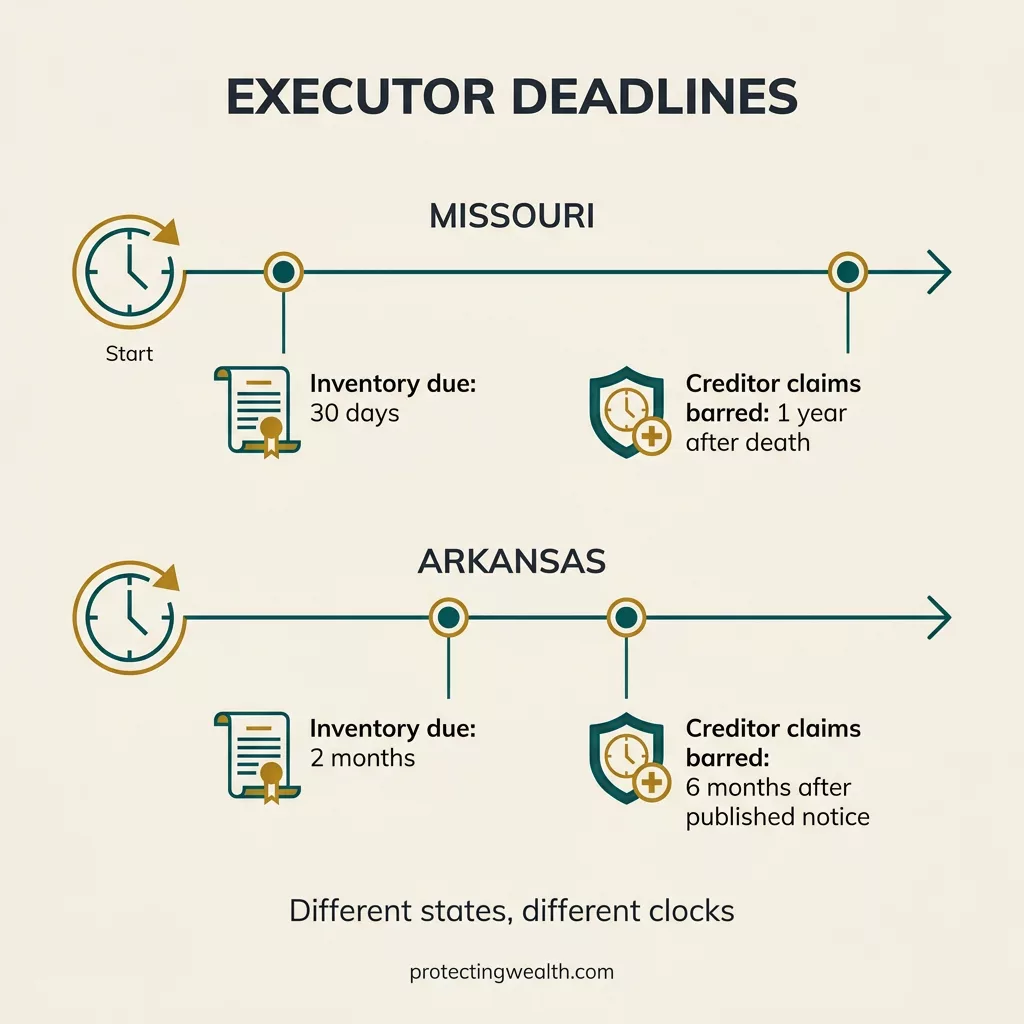
The clocks run differently: Missouri and Arkansas set different inventory and creditor deadlines.
The deadlines that create liability, state by state
Most executor problems are calendar problems. Put every one of these dates on a real calendar, not in your memory during a hard year.
Two things jump out. The inventory clocks run different lengths and start from different events, so a Joplin estate and a Bentonville estate are not on the same schedule. And Arkansas puts the mailed notice squarely on you, while in Missouri the clerk handles the publication.
Miss one and the sky doesn’t fall automatically. But you’ve handed anyone who objects to your handling a documented place to start.
Creditor claims: two states, two different clocks
This is where the states diverge most, and where merging them in your head does real damage.
In Missouri, claims that aren’t filed with the probate division within six months after the first published notice of letters are forever barred. If you actually mailed or served notice on a particular creditor, that creditor gets two months from the mailing or service, whichever period ends later. A short list of items sits outside that bar entirely, including administration costs, exempt property, the family and homestead allowances, and claims of the United States or any U.S. taxing authority.
Missouri then runs a second, separate clock. Covered claims become unenforceable one year following the date of death whether or not anyone opened an estate, and whether or not the creditor ever received notice of the death. That is a second and independent mechanism. The six-month period and the one-year bar start from different events and can run out at different times, so you have to track both.
Arkansas works differently. Claims other than administration expenses and claims of the United States are barred unless verified to you or filed with the court within six months after first publication. A creditor you serve inside the last thirty days of that window gets an extra thirty days after the period ends. And the Arkansas outer limit is five years from death, not one.
The mailed notice deserves its own line. Arkansas requires you to serve the notice on unpaid creditors whose names, status, and addresses are known to you or reasonably ascertainable. In Missouri, mailing notice is the move that starts the shorter two-month clock against a specific creditor.
One more thing that surprises people, at least on the Missouri side. Neither Missouri nonclaim statute affects an action to enforce a mortgage, pledge, or other lien on estate property. The bank holding the note on the house does not have to file a claim in order to foreclose.
Who gets paid first, and why the order matters more than the amount
When an estate can’t cover everything, the order of payment is the whole ballgame. Pay in the wrong order and the shortfall doesn’t just vanish. It becomes a question about you.
Missouri ranks claims in ten classes under RSMo 473.397, paid in this order:
1. Court costs
2. Expenses of administration
3. Exempt property, family allowance, and homestead allowance
4. Funeral expenses
5. Debts and taxes due the United States
6. Medical assistance debts owed to Missouri under section 473.398
7. Expenses of the last sickness, wages of servants, medicine and medical attendance during the last sickness, and the reasonable cost of a tombstone
8. Debts and taxes due Missouri, its counties, or its political subdivisions
9. Judgments rendered against the decedent during his lifetime
10. All other claims not barred by the nonclaim statute
Look closely at that list. The family’s exempt property and allowances rank above the funeral bill, which surprises a lot of executors. And federal debts and taxes sit at class five, three full classes above Missouri’s own state and local taxes at class eight.
Arkansas uses a shorter ladder. When the assets aren’t enough to pay all claims under Ark. Code 28-50-106, payment runs in this order:
1. Costs and expenses of administration
2. Reasonable funeral expenses, reasonable medical and other expenses of the last illness, and wages of employees
3. Claims for state taxes assessed against the decedent, due at death, or due from the estate
4. All other allowed claims
Inside any one Arkansas class, no claim gets preference over another claim of the same class. So if class two runs short, you don’t get to pay the funeral home in full and shortchange the hospital because the funeral director called you more often.
Where a mortgage or another lien sits relative to these classes is a separate question in each state. Ask about it before you rank anything, because collateral changes the picture.
The federal rule that can make you personally liable
There’s a federal statute many first-time executors have never encountered, and it’s a common route from a kind impulse to a personal bill.
A claim of the United States gets paid first when the estate of a deceased debtor in the custody of the executor isn’t enough to pay all the debts. That’s the priority half of the rule, and it only bites when the estate is short.
The second half is the one that reaches your wallet. A representative who pays any part of a debt of the estate before paying a claim of the Government is liable to the extent of that payment for the unpaid government claims. Not the whole tax bill in every case, but the amount you moved out ahead of the government.
Consider a composite illustration. It isn’t a real client, just a pattern that comes up regularly in probate. A daughter is appointed personal representative. The funeral home invoice is sitting on the counter, so she pays it from the estate account. Her mother’s credit card company calls, and she clears that too, because it feels like tidying up.
Months later, the accountant finds several years of unpaid federal income tax. The estate is now short. Those two payments she made earlier, both perfectly well-intentioned, are exactly what the statute is aimed at.
This is the real reason for the “hold off on paying bills” line at the top of this article. Whether a payment is safe generally depends on whether the estate is solvent, and that is rarely clear in the first month.
The tax filings you are responsible for
Three separate returns can land on your desk, and they are genuinely different filings. The decedent’s final individual income tax return covers the part of the year they were alive. The estate’s own income tax return covers what the estate earned during administration. Those two come up in nearly every probate.
The third is the federal estate tax return, due within nine months after the date of death. For a person who dies in 2026, the IRS filing threshold is $15,000,000, so most estates around Joplin, Springfield, and Bentonville fall well under it. Whether a return is required or advisable in a particular estate is a question for the estate’s tax advisor, since prior gifts and a surviving spouse’s planning can both affect the answer.
Two federal filings exist specifically to limit an executor’s exposure once the returns are handled:
A request for prompt assessment of the other taxes. On written request, income and other non-estate taxes must be assessed within eighteen months of the request instead of the standard period, and never later than three years from the filing date. Estate tax is excluded from that provision.
The prompt assessment request has its own form. Form 4810 is what a fiduciary files to ask for it, and it generally comes up as soon as the returns are in.
Both are worth raising with the estate’s attorney or CPA before anything is distributed. These are federal tax procedures with their own requirements and timing, and they are not automatic.
How to protect yourself while you serve
Nothing in this article makes you bulletproof. What it can do is put your decisions somewhere a court can see them.
Write down why, not just what. A one-paragraph memo explaining why you sold the truck at that price, dated the day you did it, is worth more than your recollection two years later.
Keep estate money completely separate. One account, one set of statements, no personal reimbursements without a receipt attached.
Handle notice properly and prove it. Publish where the statute requires, mail the known creditors, and keep the certificates and return receipts in the file.
Hold distributions until the claim window closes. This is the hardest one, and it’s the step most often at issue when an executor’s handling gets questioned later.
Ask the court when a decision is genuinely contested. A question raised in month four is generally easier to resolve than a dispute raised in year two.
Use the federal discharge filings described above before you wind things up.
Get counsel if the estate crosses state lines. A Missouri farm and an Arkansas house in the same estate means two sets of deadlines running at once.
Now the honest tradeoff. Doing every one of these things well makes the estate slower, and your family will feel it. Beneficiaries who expected a check in ninety days will hear “not until the creditor period closes” from you three or four times, and some of them will not take it graciously. That friction is the cost of the protection, and there’s no version of this where you get both speed and safety.
And no filing erases liability backward. The discharge filings and a closed claim window are meant to limit exposure going forward from that point, and neither one is absolute. They do not undo a payment you already made in the wrong order.
Frequently asked questions
Am I personally responsible for my parent’s debts as executor?
Generally, no. Accepting the role does not make you the debtor on your parent’s obligations. Their debts are claims against their estate, and if the estate runs out, unsecured creditors may go unpaid in whole or in part. A debt you co-signed or a joint account is your own obligation either way. Your exposure comes from your own handling, such as paying claims out of the statutory order.
How long do creditors have to file a claim in Missouri?
Six months from the date of the first published notice of letters, or two months after notice was mailed or served on that particular creditor, whichever occurs later. Missouri also runs a separate absolute bar at one year following the date of death, which applies whether or not an estate was ever opened and whether or not the creditor got any notice.
How long do creditors have to file a claim in Arkansas?
Six months after the date of first publication of the notice to creditors. A creditor you serve within thirty days of the end of that period gets an additional thirty days. Arkansas also sets an outer limit of five years after death, unless letters have issued and notice to creditors was published within that five-year window.
Can I be sued personally for a mistake I made in good faith?
Yes, good faith is not a complete shield. The federal priority rule can reach an executor who pays other estate debts ahead of a government claim, and beneficiaries can raise objections when you present your accounting. Careful documentation matters a great deal in how a court views your conduct, but it is not an automatic defense.
Do I need a bond, and does it protect me?
That depends on the estate. Missouri requires a personal representative to file a bond before entering upon the duties of the office unless it is waived, while in Arkansas the court may require a bond and must act on an interested party’s written demand. Either way, the bond runs to the benefit of the estate and interested parties. It is not insurance for you.
About the author. Christopher W. Dumm earned his J.D. from Regent University and holds a B.S. in Business Administration from the University of Missouri-Columbia. He has practiced estate planning since 1994, more than 30 years, and is licensed in Missouri, Kansas, Arkansas, Texas, and Virginia. His firm serves families from offices in Joplin and Springfield, Missouri, and Bentonville, Arkansas, with an education-first approach.
If you’ve just been appointed and the deadlines in this article are news to you, you’re exactly who should call. Reach out to our office and we’ll help you set up the estate administration so none of this lands on you personally.
Reading this article does not create an attorney-client relationship.The client stories in this article are illustrative composites based on common situations; they do not describe specific clients or promise any particular result. This article is attorney advertising and shares general information only, not legal advice. Reading it or contacting our office does not create an attorney-client relationship. Every situation is different, so talk with a licensed attorney about yours.
How to contest a will in Missouri and Arkansas: who has standing, the legal grounds courts accept, the filing deadlines, and what to expect from the process.
Does life insurance go through probate in Missouri or Arkansas? Usually no, but a few common beneficiary mistakes can pull the payout into probate court.