When a parent needs nursing home care, the first question most families ask is what it costs. The second question, usually a few weeks later, is how they are going to pay for it without losing everything their family spent a lifetime building.
I have helped families across Missouri and Arkansas plan for long-term care since 1997. In my experience, the cost itself is rarely the hardest part. Not understanding your options is.
A family that learns how Medicare, Medicaid, and a few legal tools fit together has real choices. A family that waits until the week of a hospital discharge usually does not.
This is a plain-language walk through what nursing home care actually costs in both states, what each program will and will not pay, and how families here protect their savings without breaking any rules.
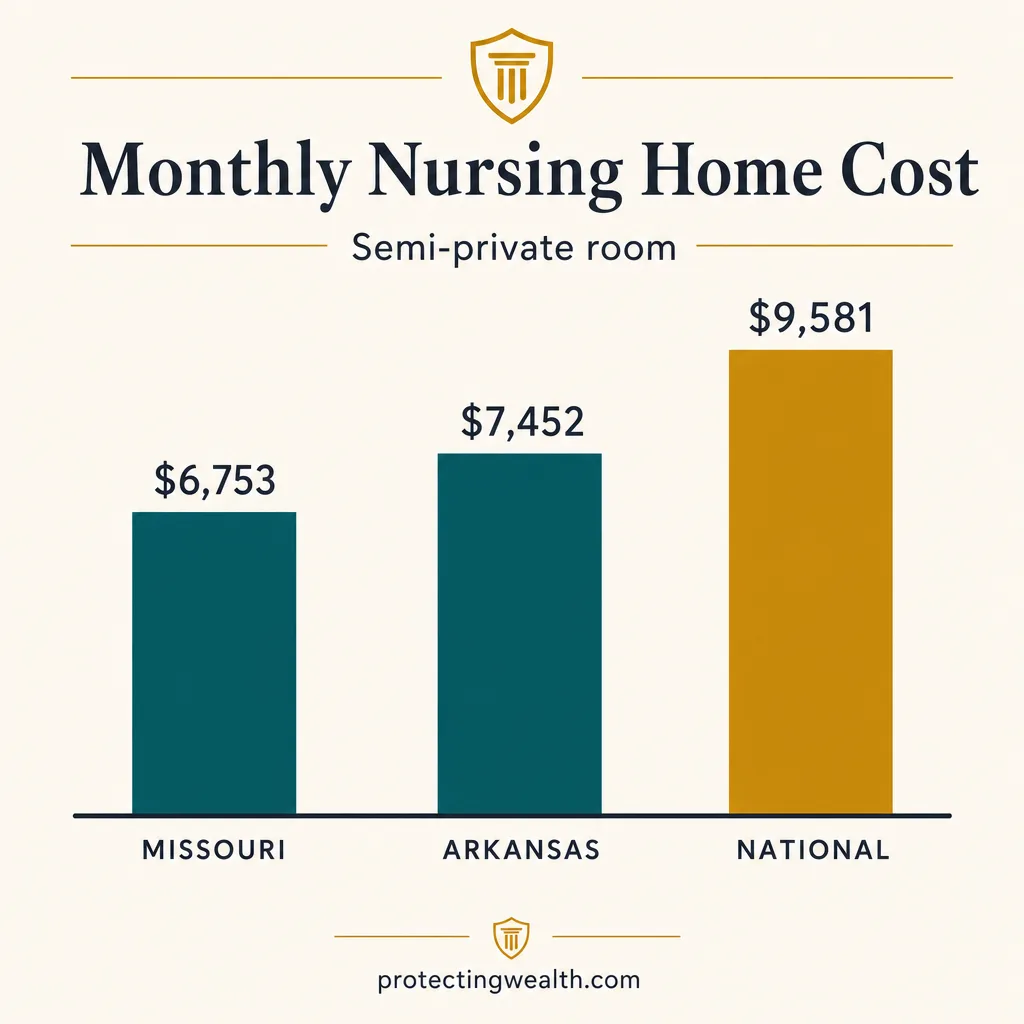
A nursing home in Missouri or Arkansas runs roughly $6,750 to $8,060 a month in the 2025 Cost of Care Survey, depending on the state and the room.
Both states sit well below the national median, which gives families here more time and more room to plan.
Medicare covers short-term skilled care only, and its coverage ends after 100 days.
MO HealthNet and Arkansas Medicaid both pay for long-term nursing home care, but only for residents who meet strict financial and medical rules that change every year.
The federal Medicaid look-back reviews five years of financial records, so gifting money or property without guidance can backfire.
Most legal asset-protection tools only work when they are set up well before a crisis.
A plan built early gives a family options. A plan built during a crisis mostly takes them away.
Median monthly nursing home cost, semi-private room (2025 CareScout Cost of Care Survey).
What Nursing Home Care Costs in Missouri and Arkansas
Missouri and Arkansas are two of the least expensive states in the country for nursing home care, and that is genuinely good news for families here. Affordable is still expensive, but the distance below the national median buys you time and room to plan.
According to the 2025 CareScout Cost of Care Survey, Missouri’s median nursing home rate is about $222 a day for a semi-private room and $250 a day for a private room, which works out to roughly $6,750 and $7,604 a month. Arkansas runs a little higher, with a semi-private room at $89,425 a year and a private room at $96,725 a year, or about $7,452 and $8,060 a month.
Both states stay below the national median, which the same survey puts at $114,975 a year for a semi-private room and $129,575 for a private room. A family in Missouri pays thousands of dollars less per month than a family in a high-cost state like Connecticut or California.
Room type
Missouri
Arkansas
National
Semi-private (monthly)
$6,753
$7,452
$9,581
Private (monthly)
$7,604
$8,060
$10,798
Semi-private (annual)
$81,030
$89,425
$114,975
Private (annual)
$91,250
$96,725
$129,575
Costs also vary inside each state. In my practice, a common situation looks like a family that gathers two quotes from facilities in the same area and finds a wide gap between them. The difference usually comes down to what each facility folds into its base rate versus what it bills separately. Before you compare two numbers, ask each facility what the base rate actually includes.
The Costs That Do Not Show Up in the Quoted Rate
The monthly rate a facility quotes covers a bed, meals, and basic nursing supervision. A lot of what a resident actually needs gets billed on top of that, and the extras add up faster than most families expect. Common add-on charges include:
Medication management and prescription administration
Physical, occupational, and speech therapy
Incontinence supplies and personal care items
Transportation to outside medical appointments
Laundry beyond a basic weekly allowance
Phone, cable, and internet
Ask for the full written fee schedule before anyone signs an admission agreement, not just the base daily rate.
Memory care is its own line item. A resident living with dementia usually needs a secured unit and higher staffing, and most facilities bill that as a higher tier rather than folding it into the standard rate. With 7.4 million Americans aged 65 and older living with Alzheimer’s in 2026, this is a question worth raising early, because it changes the budget.
Costs also climb year to year. The 2025 survey showed nursing home rates rising again, though more slowly than the 7 to 9 percent jumps reported the year before. When you build a plan, assume the number you see today will be meaningfully higher in five or ten years.
What Medicare Does and Does Not Cover
Most families assume Medicare handles a nursing home stay the way it handles a hospital bill. That assumption is one of the most expensive mistakes I see.
Medicare Part A covers skilled nursing facility care only after a qualifying inpatient hospital stay, and only for a limited time. It pays in full for the first 20 days. From days 21 through 100 you owe a daily coinsurance of $217 in 2026, and after day 100 Medicare coverage stops entirely.
The deeper issue is the kind of care Medicare pays for. It covers skilled care, meaning services delivered by licensed medical professionals such as wound care, IV medications, and physical therapy. It does not cover custodial care, the everyday help with bathing, dressing, and eating that most nursing home residents actually need. A pattern I see often is a family that places a parent in a facility after surgery, confident Medicare has it covered, then watches coverage run out while the real, long-term need is just beginning.
When Medicare ends, the bill shifts entirely to the family through private pay until another source takes over. That transition from skilled coverage to private pay is exactly where advance planning either protects a family or fails them.
How Medicaid Helps Pay for Nursing Home Care
Medicaid, not Medicare, is the program that pays for long-term nursing home care, and it is the largest public payer of long-term services and supports in the country. Missouri calls its program MO HealthNet. Arkansas calls its Arkansas Medicaid. Both will cover nursing home care for residents who meet financial and medical eligibility rules.
Those financial limits are strict, and the exact figures change every year and differ between the two states. Rather than chase a dollar amount that will be out of date by the time you read it, confirm the current limits for your own situation before you make any financial decisions. This is one area where a quick conversation prevents an expensive mistake.
The five-year look-back
Both states apply the federal Medicaid look-back. Under 42 U.S.C. 1396p, the state reviews the 60 months of financial records before a nursing home Medicaid application. If you gave away money or sold something for less than it was worth during that window, the law creates a penalty period of ineligibility. The length of that penalty is the value you transferred divided by the average monthly cost of nursing home care in the state.
This is why timing matters so much. In my practice, one of the most common and painful patterns is a parent who gifts money or property to a child out of love, with no idea that the gift will create a penalty the family has to cover out of pocket later. The look-back makes no exception for good intentions.
Protecting the spouse who stays home
When one spouse enters a nursing home and the other stays home, federal spousal impoverishment rules protect a share of the couple’s assets and income for the spouse who remains in the community. The whole point is to keep the healthy spouse from being left with nothing while paying for the other’s care. The protected amounts carry federal limits that adjust each year, so confirm the figures for the year you actually apply.
Legal Ways to Protect Savings Before a Crisis
There are legal tools that preserve savings while still working inside Medicaid’s rules, but they share one requirement: they work best when they are in place years before you need care. What follows are general descriptions, not advice for your specific situation, because the right tool depends entirely on your family and your assets.
Medicaid asset protection trusts can move assets out of your countable estate while preserving them for your heirs.
Medicaid-compliant annuities can convert countable assets into an income stream.
Spousal transfers can use the protections built in for the spouse who stays at home.
Irrevocable funeral trusts are generally exempt from Medicaid’s asset rules.
Spending down on exempt items, such as needed home repairs or a reliable vehicle, puts money to good use without violating the rules.
What none of these can do is undo a transfer made inside the five-year look-back. That is the whole reason early planning beats crisis planning. Done right, Medicaid planning uses the legal tools the law actually provides, openly and within the rules, before a crisis takes those options off the table.
Your Real Options for Paying for Care
Most families face the same short list of ways to pay for nursing home care. Here is an honest look at each.
Private pay. Personal savings are where most families start, and the math runs out faster than people expect. Even a sizable nest egg can be consumed in a few years at the rates above, which is why private pay is usually a bridge rather than a long-term answer.
Long-term care insurance. This is a real option, but premiums depend on your age and health when you apply, so the affordable window tends to close in your mid-60s. If you already hold a policy, read it closely, because benefit periods, daily limits, and inflation protection vary widely from one policy to the next.
Veterans benefits. Wartime veterans and surviving spouses should look at the VA Aid and Attendance benefit, which adds a monthly payment to a VA pension for those who need help with daily activities or who live in a nursing home. Missouri and Arkansas both have large veteran populations, and many eligible families never claim it simply because they did not know it existed.
Medicaid planning. Done early and legally, this is a structured path that families across both states use every year to cover long-term care while protecting what they can.
Alternatives to a Nursing Home Worth Considering First
A nursing home is not always the right level of care, and choosing the wrong one can mean overspending for years.
Both Missouri and Arkansas offer Medicaid home and community-based services waivers that let eligible seniors receive care at home or in an assisted living setting instead of a facility. These programs typically cover personal care assistance, adult day programs, respite for family caregivers, home safety modifications, and in-home aide visits.
Assisted living suits people who need help with daily activities but not around-the-clock medical care, and it usually costs less than a nursing home. In my practice, a recurring situation is a family paying nursing-home rates for a loved one who, on review, needs a lower level of care, where an earlier conversation about the right setting would have changed the budget. A nursing home makes sense when complex medical needs, skilled nursing, or secured memory care are genuinely required. For everything short of that, assisted living and in-home care are worth a serious look first.
The PACE program, short for Program of All-Inclusive Care for the Elderly, is another option in some communities. It provides coordinated medical and social services to seniors who qualify for nursing-home-level care but want to keep living at home. Availability varies by area, so it is worth checking what exists near you.
Three Planning Mistakes I See Most Often
Waiting for a crisis to start. Someone who reaches 65 has about a 70 percent chance of developing serious long-term-care needs, and roughly 37 percent will spend time in a nursing home. When a family calls me the week a parent is being discharged, the options that were available two years earlier have mostly disappeared. Planning early is practical, not morbid.
Assuming Medicaid turns on automatically. Medicaid is not a safety net that kicks in the moment savings run low. Eligibility depends on asset rules, income rules, a medical determination, and a clean five-year look-back history. I have watched families spend down nearly everything because no one explained the rules to them in time.
Transferring assets without legal guidance. Both states enforce the five-year look-back without exceptions for good intentions. Every transfer inside that window is subject to review, and the penalties land squarely on the family.
How Families in Missouri and Arkansas Get Ahead of This
The families who handle this well are the ones who started the conversation before they had to. Since 1997 I have helped families across Missouri and Arkansas protect what they built, and the firm is licensed in both states, which matters for families with property or relatives on each side of the line.
That early-planning philosophy is also why we built the LIFE Program, an ongoing relationship that keeps your plan current as the law and your family change, through regular reviews and educational workshops. Most plans fail not because they were drafted wrong, but because no one ever looked at them again.
If your family is facing a care decision now, or you simply want a plan in place before one arrives, a free consultation at our Joplin, Springfield, or Bentonville office is the place to start. You can request your free consultation through the contact page or call 417-623-2062. Your family built something worth protecting, and the best time to plan for it is before a crisis forces the question.
Frequently Asked Questions
Does Medicare pay for long-term nursing home care?
No. Medicare Part A covers skilled nursing facility care for up to 100 days after a qualifying hospital stay, with a daily coinsurance after day 20. It does not cover long-term custodial care, the everyday help with bathing, dressing, and eating that most nursing home residents need.
What is the difference between Medicare and Medicaid for nursing home costs?
Medicare covers short-term skilled care after a hospital stay. Medicaid, called MO HealthNet in Missouri and Arkansas Medicaid in Arkansas, covers ongoing long-term nursing home care for residents who meet the financial and medical eligibility rules. Keeping the two straight is one of the most useful things a family can do.
How does the five-year look-back work?
When you apply for nursing home Medicaid, the state reviews the prior 60 months of your finances for gifts or below-value transfers. A disqualifying transfer creates a penalty period equal to the amount transferred divided by the state’s average monthly nursing home cost, during which Medicaid will not pay.
Can a married couple protect any savings if one spouse needs a nursing home?
Yes. Federal spousal impoverishment rules protect a share of the couple’s assets and income for the spouse who stays in the community, up to limits that change each year. Because those amounts adjust annually, confirm the current figures for the year you apply.
Does hospital observation status affect Medicare coverage for a nursing home?
It can. Medicare only counts a formal inpatient admission toward the three-day qualifying stay it requires before covering skilled nursing care. If a hospital classifies your stay as observation instead of inpatient, the skilled nursing coverage that normally follows may not apply, so it is worth asking about your status while you are still in the hospital.
Are there alternatives to a nursing home that Medicaid will cover?
Yes. Both Missouri and Arkansas offer Medicaid home and community-based services waivers that fund care at home or in assisted living for seniors who meet a nursing-home level of care, which is often less expensive and closer to what families actually want.
When should we start planning for long-term care costs?
Earlier than most people think, ideally in your mid-50s to mid-60s. Long-term care insurance is cheaper when you are younger and healthier, and the legal asset-protection tools need to be in place well before the five-year look-back to do their job.
This article is for general educational purposes only and is not legal advice. Reading it does not create an attorney-client relationship with The Law Firm of Christopher W. Dumm. Laws change and every family’s situation is different, so please speak with a qualified attorney about your own circumstances before acting. Past results do not guarantee future outcomes.