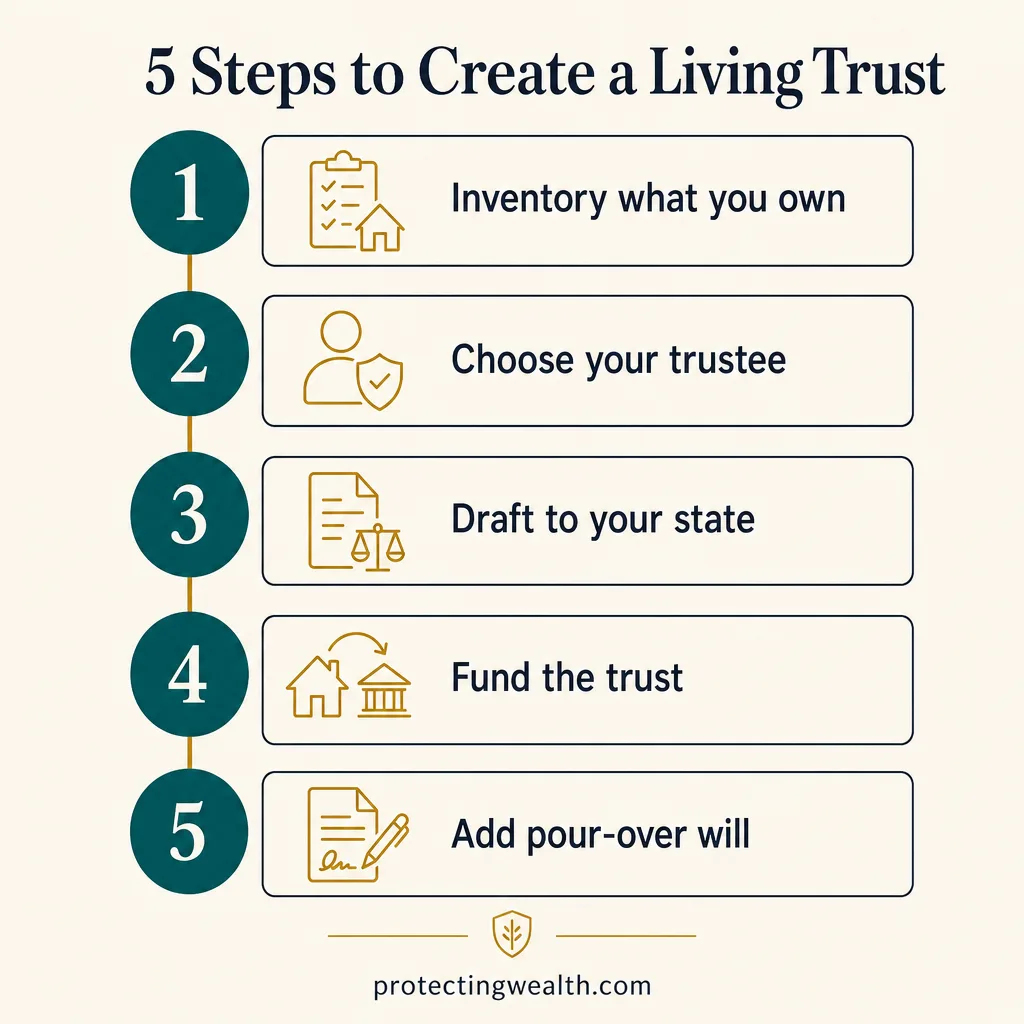
Creating a living trust comes down to five steps: take stock of what you own, name the people who will run it, draft the document to your state’s rules, move your assets into it, and pair it with a pour-over will and powers of attorney. That is the short version. The longer version is that most families do four of those steps and skip the fifth, and the one they skip is usually funding. An unfunded trust is a stack of paper that sends your estate to probate court anyway.
I have helped families across Missouri and Arkansas plan their estates since 1997, and I have watched the same gaps show up again and again. This guide walks through the whole process, the parts of it that change when you cross the Missouri-Arkansas line, and the mistakes I see most often.
A trust does nothing until you fund it by retitling your assets into its name.
Probate in Missouri and Arkansas runs on statutory fee schedules that can reach tens of thousands of dollars on a larger estate.
A revocable trust keeps you in control; an irrevocable trust trades that control for stronger protection.
Beneficiary designations on retirement accounts and life insurance override your trust, so keep them current.
Both Missouri and Arkansas require two witnesses on the pour-over will that backs up your trust.
A beneficiary deed can pass your home without probate, but it only covers that one property.
Your plan needs a review after every major life change, not just once at signing.
What a Living Trust Does That a Will Cannot
A living trust keeps your estate out of probate court, steps in if you become unable to manage your own affairs, and keeps your private business private. A will does none of those three things on its own.
Start with probate. A will still has to be proven in court before anything passes to your family. A funded living trust does not, because the assets inside it are titled to the trust rather than to you personally. Real estate, bank accounts, and investment accounts held in the trust pass to the people you named without a judge signing off.
Families confuse a will and a trust constantly, and the mix-up costs them months and real money.
The second job is the one most people overlook. Estate planning is not only about what happens after you die. It is also about who steps in if a stroke, an accident, or dementia leaves you unable to handle your own affairs while you are very much alive.
A revocable living trust names a successor trustee who can take over right away, paying bills and managing property without a court hearing or a guardianship fight among family members who suddenly disagree. A will is silent here. It speaks only after death.
A pattern I see again and again is a family that meant to set up a trust for years, then a parent has a stroke or slides into dementia before anything gets signed. Once capacity is gone, no one can sign for that parent, and the family ends up in front of a judge asking to be appointed to manage their own mother’s or father’s affairs. That process is public, slow, and exactly the kind of strain a funded trust is built to spare a family. The hard part to hear is that the trust only helps if it is in place while the person is still well enough to create it.
The third job is privacy. Once a will is admitted to probate, it becomes a public record anyone can read at the courthouse, including what you owned and who received it. A living trust handles all of that privately, among the people you chose. For families with a business, a blended household, or any reason to keep their affairs quiet, that alone can settle the question.
Revocable or Irrevocable: Which Trust Fits Your Situation
Most families I work with use a revocable living trust, because it keeps control in their hands while they are alive. An irrevocable trust trades that control for stronger protection. The right answer depends on what you are trying to accomplish.
A revocable trust bends to your life. You can change beneficiaries, swap your successor trustee, or unwind the whole thing if your circumstances shift. It avoids probate, covers you if you become incapacitated, and still lets you sell the lake house whenever you please. For most Missouri and Arkansas families, that flexibility is exactly what they want.
An irrevocable trust works differently. Once it is funded, you generally cannot pull assets back or rewrite the terms on a whim, and that rigidity is the point. Because the property is no longer yours to control, it can be shielded from creditors, lawsuits, and some long-term care costs down the road.
Families planning ahead for nursing home expenses or protecting a family business often land here, and the tradeoff is worth it for them. It is not worth it for everyone, which is why this is a conversation, not a default.
Married couples usually ask whether they need one trust or two. A shared trust keeps things simple: one document, one set of rules for both spouses. Separate trusts make more sense when there is a blended family, premarital property, or a business interest one spouse wants kept distinct. There is no universal right answer.
A few questions usually point the way: Do you have children from a prior marriage? Does one spouse own a business or significant separate property? Do you each want the freedom to update your own beneficiaries independently?
In my practice, a common situation looks like a second marriage where both spouses love each other and each brings children from before. They want the surviving spouse cared for, they want their own kids to inherit in the end, and they assume one simple shared trust does both. Sometimes that works cleanly. Just as often it creates a quiet problem, because a plain shared trust can let the surviving spouse later redirect everything to one side of the family. This is the moment separate trusts, or specific provisions written into a shared one, earn their keep, and it is worth slowing down to talk through before anyone signs.
What Missouri Law Requires Before You Create a Living Trust
Missouri follows the Uniform Trust Code, and a few state-specific details matter more than people expect. Under Missouri’s trust statute, RSMo 456.4-402, a trust is valid when you have the capacity to create it, you intend to create it, it has a definite beneficiary, the trustee has real duties to perform, and the same person is not the only trustee and the only beneficiary. Notice what is not on that list: the statute does not, by itself, require a notary for the trust to be valid.
In practice we still sign trusts in front of a notary, because it makes the document credible and because the deeds that move your real estate into the trust have to be notarized to be recorded. Treat notarization as standard practice, not as the one thing that makes or breaks the trust.
Missouri also lets smaller estates skip formal probate. The small estate affidavit under RSMo 473.097 is available when the estate, less debts and liens, does not exceed $40,000. If everything you own fits under that number, a full trust may be more than you need. The catch is that most homeowners blow past $40,000 the moment you add up a house, a vehicle, and a retirement account, and then a trust starts earning its keep.
For real estate specifically, Missouri offers a beneficiary deed under RSMo 461.025. It passes your home to a named beneficiary at death without probate, and it costs far less than a trust to set up. People often call it a transfer-on-death deed, but Missouri’s statutory name is “beneficiary deed.”
It only covers that one piece of property, though. A living trust wraps your house, your accounts, and the rest of your estate into one coordinated plan. Think of the deed as a single tool and the trust as the toolbox.
One recent change is worth knowing if your trust will hold out-of-state income. Starting with tax years that begin on or after January 1, 2026, Missouri’s HB 754 amended RSMo 143.341 to let a qualifying resident irrevocable trust subtract income that would not be taxed if the trust were treated as a nonresident. That makes Missouri more competitive for trust management than it used to be. It is also technical, and how it affects you depends on your situation, so raise it with us and your tax advisor rather than acting on a summary.
What Arkansas Law Requires Before You Create a Living Trust
Arkansas sets out the same core trust requirements as Missouri. Under the Arkansas Trust Code, Ark. Code 28-73-402, a trust is valid when you have capacity, you intend to create it, it has a definite beneficiary, the trustee has duties, and the same person is not the sole trustee and sole beneficiary. As in Missouri, notarization is standard practice rather than a statutory validity test for the trust itself.
The documents that travel with your trust are where the witnessing rules come in, and they are easy to get wrong. A pour-over will needs two witnesses under Arkansas law, Ark. Code 28-25-103. Missouri requires two witnesses for a will too, under RSMo 474.320, so neither state lets you shortcut the will that backs up your trust. Miss a witness signature and the will tied to your trust can be challenged later, which is why we check every signature line ourselves.
Arkansas sets its small estate bar higher than Missouri. The small estate affidavit under Ark. Code 28-41-101 is available when the property left by the decedent, less encumbrances and excluding the homestead and statutory family allowances, does not exceed $100,000, and at least 45 days have passed since death. That is a generous threshold, but the same reality applies: once a house and its equity enter the picture, most families exceed it.
Arkansas also has a beneficiary deed statute, Ark. Code 18-12-608, so your homestead can pass at death without probate the same way it can in Missouri. The deed has to be recorded before you die to be valid, and it can even transfer property to the trustee of your trust. A beneficiary deed handles one asset, though.
Your bank accounts, investments, and everything else still need a plan, which is what the trust provides. The deed is a useful supplement, not a substitute, especially if you own property in more than one state or want incapacity protection built in.
The five steps to create and fund a living trust.
The Step-by-Step Process for Creating Your Living Trust
The mechanics are the same on both sides of the state line. The order is what keeps a plan from developing gaps.
Step 1: Take a full inventory of what you own. Before anyone drafts a word, list it all: real estate, bank and investment accounts, retirement accounts, business interests, life insurance, even the classic truck in the garage. A trust can only be built to fit your life once you know what your life actually contains. Skipping this step is how families end up with assets stranded outside the trust.
Step 2: Choose your trustee and a solid successor trustee. You will most likely serve as your own trustee at first, keeping full control. The real decision is who steps in when you cannot. Pick someone organized, trustworthy, and willing to handle paperwork under pressure. It does not have to be your oldest child; choose for capability, not birth order, and always name a backup.
Step 3: Draft the trust to your state’s rules. Once your goals are clear, we draft the trust to reflect them, not pull it from a generic template. Missouri and Arkansas each have their own requirements, and getting them wrong can unravel the plan. We sign in front of a notary as a matter of practice, even though the statute focuses on capacity and intent.
Step 4: Fund the trust by retitling your assets. A signed trust sitting in a drawer protects no one. Funding means retitling your real estate, bank accounts, and investment accounts into the trust’s name. This is the single most skipped step in estate planning, and it is the reason unfunded trusts still end up in probate. We walk every client through this part personally.
Step 5: Pair the trust with a pour-over will and powers of attorney. Your trust needs backup. A pour-over will catches any asset you forgot to move and directs it into the trust at death. Add a durable power of attorney and health care directives, and your plan now covers both death and incapacity. Without these companions, even a well-funded trust leaves gaps.
What to Put in Your Living Trust and What to Leave Out
Most of your major assets belong in the trust. A few specific accounts are better left out, because moving them in can cause tax problems. The table below shows the usual split, and the reasoning behind each one.
Asset
In the trust?
How and why
Primary residence and other real estate
Yes
Retitle with a new deed naming the trust as owner, which keeps the property out of probate and private
Bank and investment accounts
Yes
Retitle the account directly with your bank or brokerage so it passes to your beneficiaries without court involvement
Business interests
Yes
Transfer through a formal assignment so succession does not disrupt operations
Retirement accounts (IRAs, 401(k)s)
No
Keep titled in your name and use beneficiary designations; retitling can trigger an unwanted tax event
Life insurance
No
Names a beneficiary directly and already bypasses probate through that payout
Digital and online accounts
Yes
Add explicit access language so your trustee has documented authority to reach the accounts
Real estate goes in through a new deed, recorded with the county. You retitle bank and investment accounts directly with your bank or brokerage, naming the trust as owner. Business interests usually transfer through a formal assignment. Each asset type has its own process, and missing even one leaves a gap your family discovers at the worst possible time.
A pattern I see often is an estate where most of the value sits in one thing that cannot be split easily, a working farm or a family business. The owner sets up a trust but never formally assigns the business interest into it, so the one asset that needed the most careful handling is the one left exposed. When the whole estate is tied up in something illiquid, the planning question is not just who inherits it but how they take it on without being forced to sell it to cover costs or to buy out relatives who wanted cash instead. That takes deliberate drafting rather than a generic form.
Retirement accounts are the main exception. IRAs and 401(k)s generally stay titled in your own name. Retitling them into a trust can trigger a tax event, sometimes treating the move as a full distribution. Instead, these accounts pass through their beneficiary designations, which is exactly why keeping those forms current matters so much.
The same logic applies to life insurance, which already pays out directly to the beneficiary you named. We review beneficiary designations every time we update a client’s plan.
Digital property is the newer wrinkle. Missouri’s Fiduciary Access to Digital Assets Act, RSMo 472.400 and following, governs how your trustee reaches online accounts, from banking to cloud storage, after you are gone. Your documents need explicit language granting that access, or your trustee can hit a wall of locked accounts and unhelpful customer service. We build that authority into the plans we draft, because online property is part of nearly every estate now.
Three Mistakes Missouri and Arkansas Families Make
The same three errors account for most of the trusts I see fail. All three are preventable.
Creating the trust but never funding it. This is the one I see most. A family pays for a well-drafted trust, signs it, files it in a drawer, and never retitles the house or the accounts into the trust’s name. An unfunded trust offers zero probate protection; it is an expensive piece of paper. Funding is not optional, and it is not a one-afternoon afterthought.
In my practice, the funding gap is rarely the family that ignores the whole job. It is more often the one asset that slips through: a rental across the state line, an account opened after the trust was signed, a piece of land nobody thought of as part of the estate. The trust covers what was moved into it and nothing else, and the gap usually surfaces years later, at the worst possible moment, when the family is trying to settle things. That is why I walk through funding asset by asset rather than handing someone a checklist and wishing them luck.
Letting beneficiary designations drift out of date. Your trust can be flawless and an outdated beneficiary form will still override it. Life insurance and retirement accounts pass to whoever is named on the form, no matter what your trust says. I have seen an ex-spouse still listed years after a divorce, which creates exactly the family conflict the client was trying to avoid. Review these forms every time your plan changes.
Failing to update after a major life change. A trust is not a one-time errand. The events that should trigger an update are easy to name: marriage, divorce, or remarriage; the birth or adoption of a child or grandchild; buying or selling significant property or a business; and a move across state lines. A plan that reflects the family you had a decade ago is a plan with a problem waiting to surface.
What a Living Trust Costs, and What Probate Costs Without One
An attorney-drafted trust costs more upfront than a do-it-yourself form, and far less than what probate can pull out of an unplanned estate. The honest tradeoff is real money now for a coordinated plan, versus a cheaper start that can cost your family much more later.
Online services and DIY kits advertise low prices, and for a genuinely simple situation they can produce a valid-looking document. What they cannot do is ask you the right questions. A template does not know that your son just went through a divorce, that you own a rental across the state line, or that your daughter has a child with special needs. That is the part a planning conversation is actually for.
The cost of skipping a plan is set largely by statute, and it is not small on a larger estate. The table below compares how Missouri and Arkansas handle the fees that come with probate.
Add court costs, publication of creditor notices, and any required bond on top of those fees, and the total climbs from there. On a $500,000 estate, the combined statutory attorney and personal representative fees alone can run well into the tens of thousands before your family receives a dime.
Paying once, while you are healthy and clear-headed, generally beats paying more later under stress. That is the math, and it is why I encourage families to plan early rather than leave the bill for the people they love.
How Missouri and Arkansas Families Get This Right
A living trust is not a document you sign and forget. The plans that work are the ones that stay current as the family changes, and that is the part most people have no system for.
I have practiced estate planning since 1994, licensed across Missouri, Kansas, Arkansas, Texas, and Virginia, and the regional differences between these states are exactly what a generic template cannot account for. The families we serve are farmers, business owners, retired teachers, and everyone in between, and what they have in common is wanting a plan that still fits years from now.
That is why we built the LIFE Program. It keeps your plan current through regular reviews, educational workshops, and ongoing support as your life changes, so the trust you set up today does not quietly drift out of date. Most trusts do not fail because they were drafted wrong. They fail because no one ever looked at them again.
If you are weighing whether a living trust fits your family, request a free consultation through the contact page or call 417-623-2062, and we can sit down at our Joplin, Springfield, or Bentonville office. Bring what you already have and the questions your family has raised, and we will talk through how the pieces fit.
Frequently Asked Questions
How long does it take to create a living trust in Missouri or Arkansas?
Most living trusts take about two to four weeks from your first meeting to a fully signed and notarized document. Estates with business interests, blended-family considerations, or significant property can take longer, mainly because funding the trust and coordinating the pour-over will and powers of attorney takes more time than the drafting itself.
Do I still need a will if I have a living trust?
Yes. You need a pour-over will as a safety net. It catches any asset you did not move into the trust during your life and directs it into the trust at death, which keeps that property from passing under your state’s intestacy laws. A trust and a pour-over will are designed to work together, not as substitutes.
Can a living trust help me avoid estate taxes?
A revocable living trust does not reduce federal estate tax exposure on its own, because the federal exemption already shields most estates and the assets are still treated as yours during life. Larger estates sometimes use irrevocable structures for genuine tax planning, but that is a separate strategy from the basic revocable trust most families use to avoid probate.
Does a living trust protect my assets from creditors?
A revocable living trust generally offers no creditor protection while you are alive, because you keep full control of the assets. An irrevocable trust, sometimes with a spendthrift provision, can offer stronger protection for the property inside it, which is one reason families considering long-term care costs look at irrevocable options.
Who should I choose as my successor trustee?
Choose someone organized, trustworthy, and capable of handling financial paperwork under pressure, not simply your oldest child by default. The role carries real fiduciary duties, so capability matters more than birth order, and you should always name an alternate in case your first choice cannot serve.
What happens to my home if I do not fund my trust?
A home left out of the trust still passes through probate, which defeats much of the reason you set the trust up. In Missouri and Arkansas you can retitle the home into the trust with a new deed, or use a beneficiary deed as a backstop for that one property. Confirming that your real estate is actually titled correctly is part of what makes a plan complete.
What if I have a child with special needs?
A special needs trust can hold an inheritance for a loved one without disqualifying them from means-tested benefits like Medicaid or Supplemental Security Income. It is drafted differently from a standard living trust and is usually built alongside your main plan, often coordinated with tools like an ABLE account. Because the rules are strict, this is one area where careful drafting matters most.
Where should I keep my trust documents?
Keep the signed originals somewhere your successor trustee can reach quickly, such as a clearly labeled location at home and a secure digital copy. A bank safe deposit box can be harder to access right after a death, which can delay your trustee at exactly the wrong moment. Make sure the people who will act for you know where the documents are and how to get to them.
This article is for general educational purposes only and is not legal advice. Reading it does not create an attorney-client relationship with The Law Firm of Christopher W. Dumm. Laws change and every family’s situation is different, so please speak with a qualified attorney about your own circumstances before acting. Past results do not guarantee future outcomes.