A husband and wife come in with a legal pad between them, which happens more often than you’d guess. On one line she’s written what her sister told her at Thanksgiving, on the next what a fellow at the coffee shop told him, and the two lines say opposite things. That’s usually how the revocable vs. irrevocable trust conversation starts around here, with two trusted voices pulling in different directions and nobody able to say which one has it right.
I’ve been doing estate planning since 1994, so more than 30 years of these conversations, and the confusion isn’t anybody’s fault. The two documents share a last name and almost nothing else. One of them you can change on a Tuesday afternoon because you felt like it. The other one is a decision you make once, on purpose, and choosing it for the wrong reason costs real money to fix, takes real time, and sometimes can’t be fully undone.
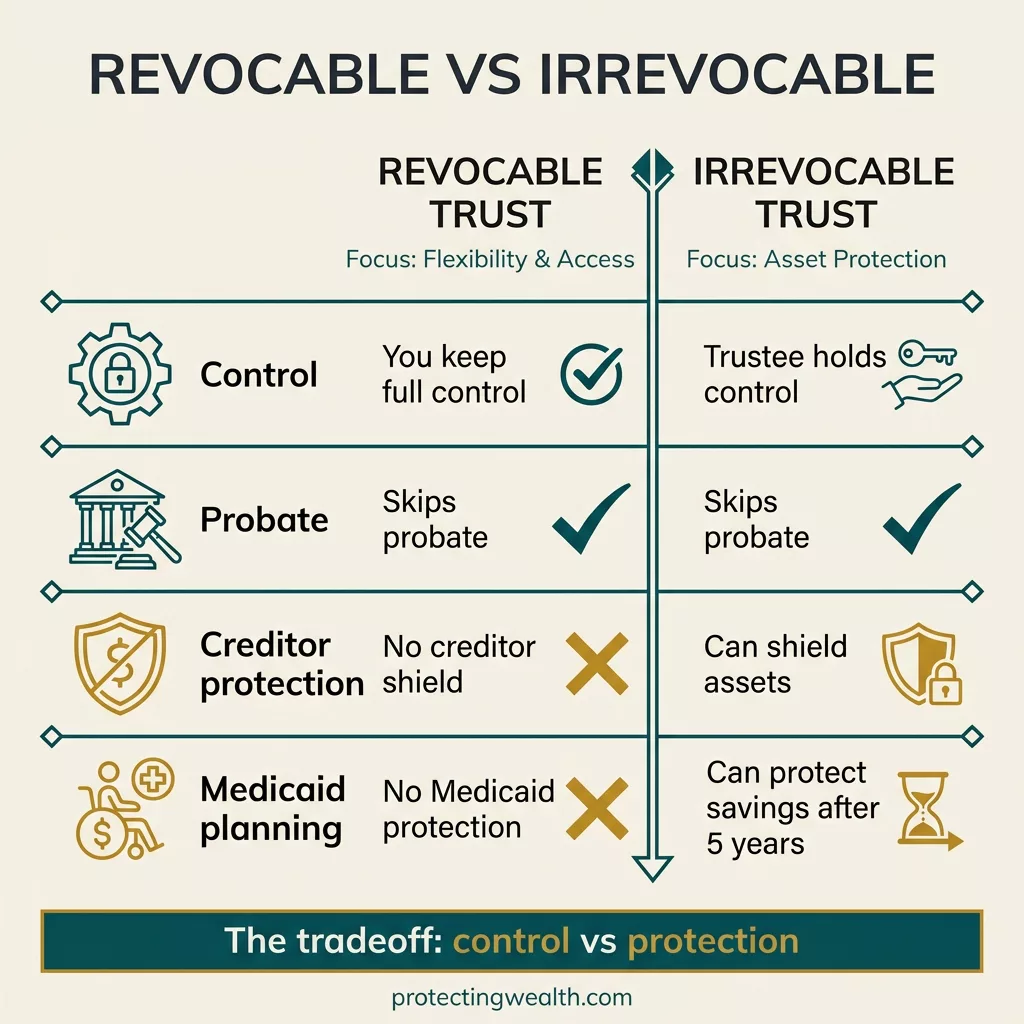
A revocable trust keeps you in complete control of your own property, an irrevocable trust trades away some of that control in exchange for a measure of protection, and for most families I sit with in Southwest Missouri and Northwest Arkansas the revocable trust is the right core document. The irrevocable trust is a specialty tool, wonderful when the job calls for one and expensive when it doesn’t.
Here’s the comparison I sketch out on a legal pad about once a week.
Revocable Trust
Irrevocable Trust
Can you change it?
Yes, any time you have capacity
Generally no, though terms can sometimes be adjusted
Avoids probate
Yes, for assets titled into it
Yes, for assets titled into it
Protects from your creditors
No, by statute in both states
Can, if drafted and timed correctly
Counted for Medicaid
Yes, treated as yours
Depends on timing and drafting
Who pays income tax on it
You do, on your own return
Depends on the type of trust
Step-up in basis at death
Yes
Depends on the drafting
Typical fit
The main household plan
One asset or one specific risk
Notice how many of those irrevocable answers start with “depends.” The details of the drafting genuinely change the answer, which is exactly why nobody should choose an irrevocable trust off a chart.
Neither trust does a single solitary thing until it’s funded. An unfunded trust is a very nicely bound stack of paper in a drawer.
The core tradeoff: control stays with a revocable trust, protection comes from an irrevocable one.
Control: who can change the trust after you sign it
With a revocable trust, you keep every bit of the control you have right now. You can amend it, restate it, pull property back out, or throw the whole thing in the fireplace, so long as you have capacity to make that decision. An irrevocable trust asks you to hand the reins to a trustee who isn’t you.
In both states, whether a trust is revocable or irrevocable is a drafting choice, and the default runs toward revocable. Missouri’s Uniform Trust Code, effective January 1, 2005, says that unless the terms of a trust expressly provide that the trust is irrevocable, the settlor may revoke or amend the trust. Arkansas adopted its Trust Code that same year and takes the same approach at Ark. Code 28-73-602.
So permanence never happens to a trust by accident. Somebody has to write it in, and if you’re not sure which kind you have, the document itself will say.
The control question is also about what happens if you can’t make decisions anymore. A revocable trust names a successor trustee who steps in and manages things without anybody filing for a guardianship or conservatorship in front of a judge. That matters more every year, and the Alzheimer’s Association reports in its 2026 Facts and Figures that an estimated 7.4 million Americans age 65 and older are living with Alzheimer’s in 2026.
After you sign a revocable trust, here’s what you can still do without asking anyone’s permission:
Sell the house, buy a different one, and put the new one in the trust
Refinance the mortgage
Change who gets what, and in what shares
Add a new grandchild to the list
Move money in and out of trust accounts
Amend the whole document, or revoke it and start over
Probate avoidance: both work, and this is where most families stop reading
On probate, it’s a tie. Anything actually titled in the name of either trust passes under the trust’s terms without going through a probate court. So if probate avoidance is your goal, a revocable trust gets you there without asking you to surrender control.
The uncomfortable part first. In more than 30 years, the trust that fails in my practice is almost never the one where somebody picked the wrong type. It’s the one that was never fully funded, with beautiful drafting and a house still sitting in the couple’s individual names because nobody ever recorded the deed.
Funding is clerical work, and clerical work is easy to put off. A deed has to be prepared and recorded with the county recorder where the property sits, and bank and brokerage accounts have to be retitled at each institution.
Here’s the rough sorting I walk clients through:
Generally retitle into the trust: the house, farm ground, rental property, bank and brokerage accounts, and business interests (subject to any operating agreement)
Generally leave outside the trust: IRAs, 401(k)s, and other retirement accounts, which pass by beneficiary designation and can create income tax headaches if retitled
Check the beneficiary designations: life insurance and annuities pass by designation too, and those forms should line up with the rest of the plan
Keep a pour-over will: it catches whatever didn’t make it into the trust
People often tangle probate together with Medicaid in their heads. Missouri has an estate recovery process, and RSMo 473.398 requires a release from MO HealthNet before a probate estate of an enrolled decedent can close. The statute allows no recovery for benefits received before age 55, and recovery is barred where it would adversely affect a surviving spouse or dependents.
Asset protection: what Missouri and Arkansas law actually say
A revocable trust gives you no protection from your own creditors. None. That’s the statute talking rather than my opinion, and I’m plain about it because people arrive convinced otherwise. RSMo 456.5-505.1 says it in words nobody can wiggle out of: “Whether or not the terms of a trust contain a spendthrift provision, during the lifetime of the settlor, the property of a revocable trust is subject to claims of the settlor’s creditors.”
Arkansas says the same thing in nearly the same breath. Ark. Code 28-73-505 reads: “During the lifetime of the settlor, the property of a revocable trust is subject to claims of the settlor’s creditors.” If you kept the power to take it back, the law treats it as still yours.
The irrevocable side is where the real protection lives, and where the fine print lives too. Under RSMo 456.5-505.3, a spendthrift provision in an irrevocable trust can prevent the settlor’s creditors from satisfying their claims out of trust assets. The statute carves out two important exceptions, though, and I read both of them out loud before anybody signs.
The first exception is timing. If the transfer of assets into the trust was fraudulent as to creditors under Chapter 428, the protection doesn’t hold. The second is structure. To the extent of the settlor’s own beneficial interest, protection can fail if, at the time the trust became irrevocable, the settlor was the sole beneficiary of income or principal, retained the power to amend the trust, or retained a right to a specific portion determinable from the trust document itself.
Arkansas takes its own path here. Ark. Code 28-72-702 permits a trust where the settlor is also a beneficiary. It comes with a condition, though. At least one trustee has to be a natural person domiciled in Arkansas, or a trust company or bank with trust powers that maintains an Arkansas office.
This kind of protection can work when the trust is set up correctly and set up early, and a trust funded after a claim already exists doesn’t do the job. You can’t watch a lawsuit coming down the road and then move the farm.
Three things have to line up:
Timing. The transfer happens well before any claim, dispute, or care need exists
Structure. You genuinely give up control, and you don’t quietly keep the strings the statute lists
Trustee. Somebody other than you administers it, and in Arkansas the residency rule applies
Long-term care and the five-year clock
This is the real reason most people in my office ask about irrevocable trusts, and almost nobody says it in the first ten minutes. They ask about trusts, and what they mean is what happens to the house if they go into a nursing home.
Medicaid looks backward at what you gave away before you applied. Federal law sets a look-back period of 60 months for any disposal of assets made on or after February 8, 2006, at 42 U.S.C. 1396p(c)(1)(B). Gifts and below-value transfers inside that window get examined, and that window is the five-year clock people have heard about.
Where folks get lost is what happens when a transfer falls inside that window. According to CMS, the penalty takes the amount transferred for less than fair market value and divides it by the average monthly private-pay cost of nursing facility services in that state. That’s why a transfer penalty comes out in months of care rather than in dollars, and why its size depends on what care costs where you live.
Which brings us to what care costs around here. The CareScout Cost of Care Survey 2025, published in March 2026, reports these annual medians:
Private nursing home room, Missouri: $91,250
Private nursing home room, Arkansas: $96,725
Private nursing home room, national: $129,575
Assisted living, Missouri: $64,800
Assisted living, Arkansas: $55,644
A revocable trust does nothing for you here. Since you can pull the assets back out any time you like, they’re treated as available to you. Retitling the house into one changes who holds title and doesn’t change the Medicaid math one bit.
An irrevocable trust can be a different story when there’s runway, since the strategy depends on making the transfer far enough ahead that the look-back window has closed by the time care is needed. I’ve written separately about irrevocable Medicaid asset protection trusts. One caution about eligibility numbers you read online, mine included. Those limits differ by state and get adjusted regularly, so confirm the current figures for your state rather than relying on a published article.
What the five-year clock does and doesn’t reach:
Reaches: gifts to children, transfers to most irrevocable trusts, selling property to family below market value, adding a child to a deed
Doesn’t reach: transfers made more than 60 months before the application, plus certain protected transfers such as those involving a spouse
Doesn’t apply: to a revocable trust, since nothing was ever really given away
Worth knowing: the penalty starts when you’d otherwise be eligible, so it lands at the worst moment
Taxes: the question almost nobody around here actually has
For nearly every family I sit with, federal estate tax simply isn’t in the picture. The IRS says that “estates of decedents who die during 2026 have a basic exclusion amount of $15,000,000, up from a total of $13,990,000 for estates of decedents who died in 2025,” which you can read in the full inflation adjustment announcement.
A married couple with proper planning is looking at roughly double that figure. The annual gift exclusion for 2026 is $19,000.
Income tax is simpler than folks expect. A revocable trust has no separate tax life while you’re living, since its income flows onto your own return, and in my experience these trusts have rarely needed their own tax identification number. Irrevocable trusts vary depending on the drafting, and some are taxed to the grantor while others file their own returns.
The next one is what I’d call the most expensive unforced error in this whole area of law. Under IRC 1014, property acquired from someone who has died takes a basis equal to fair market value on the date of death, which is what people mean by the “step-up.” Under IRC 1015, property given away during life generally carries the giver’s original basis instead.
Move appreciated farm ground into an irrevocable trust without thinking that through, and the family can inherit a capital gains problem nobody saw coming. Whether a particular irrevocable trust preserves the step-up depends entirely on the drafting.
Three questions worth asking before you sign anything irrevocable:
Does this trust preserve the step-up in basis at my death, and how does the drafting accomplish that?
Who reports the trust’s income while I’m living, and does the trust need its own tax identification number?
What’s the original basis on the property I’m moving, and how much has it appreciated since we bought it?
Irrevocable doesn’t mean unchangeable
Permanence has a narrower meaning here than the word suggests. The assets are the part you can’t undo, since what goes into an irrevocable trust isn’t coming back to you. The terms are another matter, and they can sometimes be adjusted. Both Missouri and Arkansas provide legal routes for doing it.
The first route is a nonjudicial settlement agreement. RSMo 456.1-111 lets interested persons enter a binding agreement on any matter involving a trust, valid only to the extent it doesn’t violate a material purpose of the trust and includes terms a court could properly approve. Enumerated matters include interpreting the trust’s terms, approving a trustee’s accounting, directing a trustee, trustee resignation or appointment, trustee compensation, and moving the principal place of administration. Arkansas has a parallel provision at Ark. Code 28-73-111.
The second route is decanting, which is about what it sounds like. RSMo 456.4-419 lets a trustee other than the settlor, holding discretionary power to distribute income or principal, exercise that power in favor of the trustee of a second trust when the trustee decides it’s necessary or desirable given the terms and purposes of both trusts. At least one permissible distributee of the first trust has to remain a permissible distributee of the second. Arkansas has its own decanting statute at Ark. Code 28-73-818.
A word about the limits, because I don’t want anyone signing an irrevocable trust thinking there’s an easy exit. All of these routes cost money and take time, and every one of them needs the trustee and the beneficiaries on board. None of them hands the assets back to you.
The routes that exist, and who has to agree:
Nonjudicial settlement agreement. The interested persons, and it can’t violate a material purpose of the trust
Decanting. The trustee (someone other than you), exercising discretion into a second trust
Trustee change. Often the easiest adjustment, depending on what the document allows
Court modification or termination. Available in some circumstances, with the expense a court proceeding brings
Which one fits which family
One pattern stands out over 30-plus years. Nearly every family that walks in asking for an irrevocable trust wants one of three things, and two of them usually don’t require giving up control at all.
Keep the kids out of probate court, which a funded revocable trust handles
Protect the house from long-term care costs, which is the one that may call for an irrevocable trust
Keep an adult child from losing a benefit, which usually calls for a special needs trust
Let me walk through four situations I see regularly. These are illustrative patterns rather than actual clients, and none of them promises how anything turns out.
Start with the healthy couple in their sixties, paid-off house and retirement accounts, no creditor worries, wanting a legacy instead of a year of the kids in probate court getting cross with each other. A properly funded revocable trust, powers of attorney, and healthcare directives generally do that job, and an irrevocable trust here would be a solution looking for a problem.
Then the widow in her seventies whose husband passed a few years back, with the house her only real asset besides a modest IRA and a nursing home on her mind. This pattern deserves a real long-term care conversation, including whether an irrevocable structure makes sense given her age, her health, and how much runway the five-year clock leaves her.
A third pattern is the farmer or small business owner with equipment, employees, livestock, or customers on the property, who knows things happen. Here a revocable trust handles the estate side while the protection question gets answered separately, often through business entities and insurance first, with an irrevocable trust for one particular asset if the exposure and timing justify it.
Finally, parents of an adult child receiving SSI and Medicaid, wanting to leave something behind without disrupting the benefits he depends on, since a straightforward inheritance can do exactly that damage. This pattern generally calls for a special needs trust designed for the purpose, alongside the parents’ own revocable trust, and coordinating the two matters as much as either one alone.
Plenty of families end up with both, a revocable trust running the household plan and a separate irrevocable trust carved out for one asset or one specific risk.
The Bottom Line
Start with what you’re actually afraid of, then pick the instrument. If the fear is your kids stuck in court arguing over who gets the lake cabin, a revocable trust that’s genuinely funded handles it and you keep control of everything. If the fear is a nursing home eating the farm, that’s a different conversation, it involves the five-year clock, and it works better the earlier you have it.
I’d rather teach you the difference than sell you a document. That’s why we hold free educational workshops in Joplin and Springfield, where you can hear all of this and ask questions without anybody following up to pressure you. If a conversation would help, you’re welcome to reach out to our office in Joplin, Springfield, or Bentonville. There’s no rush on any of this.
Frequently Asked Questions
Does a revocable trust protect my house from a nursing home?
No. Because you can revoke the trust and take the house back any time, the law treats that house as still available to you. Missouri and Arkansas statutes both say revocable trust property stays subject to your creditors during your lifetime, and Medicaid applies similar logic. Protecting a home from long-term care costs involves different tools and, importantly, enough lead time before care is needed.
Can an irrevocable trust ever be changed?
Sometimes the terms can be adjusted, though the assets don’t come back to you. Both states allow nonjudicial settlement agreements among interested persons, so long as the change doesn’t violate a material purpose of the trust. Both also have decanting statutes that let a trustee move assets into a second trust with different terms. All of it takes cooperation, costs money, and has real limits.
Do I still need a will if I have a trust?
Yes, and I’d want you to have one. It’s called a pour-over will, and it acts as a safety net for anything that never made it into the trust. It also names guardians if you have minor children, which a trust can’t do. Nobody funds a trust perfectly, so the will catches whatever got missed.
Can I have both a revocable and an irrevocable trust?
You can, and plenty of families do. A common arrangement uses a revocable trust for the everyday estate, meaning the house, the accounts, and the personal property, plus a separate irrevocable trust holding one particular asset or addressing one particular risk. The two documents need to be drafted with each other in mind so they don’t work at cross purposes.
What happens to my trust if I move from Missouri to Arkansas?
Your trust doesn’t stop working when you cross the state line. Missouri and Arkansas both adopted trust codes in 2005 with a great deal of shared language, so most provisions travel fine. That said, deeds, beneficiary paperwork, and the trustee provisions are worth a review after a move, and Arkansas has some rules of its own. A short check-in with an attorney licensed in your new state is usually enough.
About the Author
Christopher W. Dumm, J.D., has practiced estate planning since 1994, more than 30 years, and is the founder of The Law Firm of Christopher W. Dumm. He is licensed in Missouri, Kansas, Arkansas, Texas, and Virginia, with offices in Joplin and Springfield, Missouri, and Bentonville, Arkansas. His memberships include WealthCounsel, ElderCounsel, and the National Academy of Elder Law Attorneys. He also serves as an adjunct professor.
The client stories in this article are illustrative composites based on common situations; they do not describe specific clients or promise any particular result. This article is attorney advertising and shares general information only, not legal advice. Reading it or contacting our office does not create an attorney-client relationship. Every situation is different, so talk with a licensed attorney about yours.
How to create a living trust in Missouri and Arkansas: the five steps, the state signing rules, what to fund, and the mistakes that send a trust to probate anyway.