Advance directives and living wills are the legal documents that put your medical wishes in writing before a crisis forces someone else to guess. And trust me, after 27 years of helping Missouri and Arkansas families through these moments, I can tell you that the guessing never goes well. One document covers end-of-life care specifically. The other is a broader set of health care decisions that speaks for you across a much wider range of medical situations. Most people assume they are the same thing. They are not, and that mix-up leaves real families in real trouble. Let’s clear that up right now.
A living will and an advance directive are not the same thing, and assuming they are is one of the most common and costly mistakes.
Missouri calls it a “declaration concerning death-prolonging procedures” and has stricter signing requirements, including both witnesses and a notary public.
Your health care agent is the most consequential choice in this entire process, so pick someone available, emotionally steady, and genuinely aligned with your values.
Without a properly executed advance directive, state law decides who speaks for you, and that person may not be who you would have chosen.
Vague language in your document is almost as dangerous as having no document at all.
A document no one can find in an emergency is a document that does not exist. Store it right, share it widely, and carry a wallet card.
Estate plans are not set-it-and-forget-it. Divorce, diagnosis, relocation, and the passage of time can all make your current documents work against you overnight.
Advance Directives and Living Wills Are Not the Same Thing
The Umbrella and the Tool Inside It
Think of advance directives as the umbrella category and a living will as one specific tool that fits underneath it. Every living will is an advance directive, but not every advance directive is a living will. The broader category also includes your health care power of attorney, DNR orders, and POLST forms. I explain it to families this way: the umbrella keeps everything dry, but you still need to know which part covers your head.
What a Living Will Actually Covers vs. What It Leaves Out
A living will is a written legal document that speaks specifically to end-of-life care when you are terminally ill or permanently unconscious. It tells your medical team and family members whether you want life-sustaining treatment, artificial nutrition, mechanical ventilation, or comfort-focused pain management instead. What it does not do is appoint anyone to make health care decisions for you in situations your document did not specifically anticipate. That gap is exactly where families run into serious, avoidable problems during a medical crisis.
Why Having Only One of These Documents Leaves Dangerous Gaps
A 68-year-old retired schoolteacher from Joplin came to our office in 2021 carrying a living will she had signed fifteen years earlier and assumed she was covered. She had no durable power of attorney for health care and no named health care agent whatsoever. When we walked through a scenario where she suffered a stroke but was not terminally ill, her living will would not have activated at all, and no one would have had legal authority to make her medical decisions.
According to aHealth Affairs meta-analysis covering nearly 800,000 people across 150 studies, only 36.7% of U.S. adults have completed any advance directive, and just 29.3% have a living will specifically. Most families assume one document is enough. In my 27 years of working with Missouri and Arkansas families, I can tell you that assumption is one of the most common and most fixable mistakes I see.
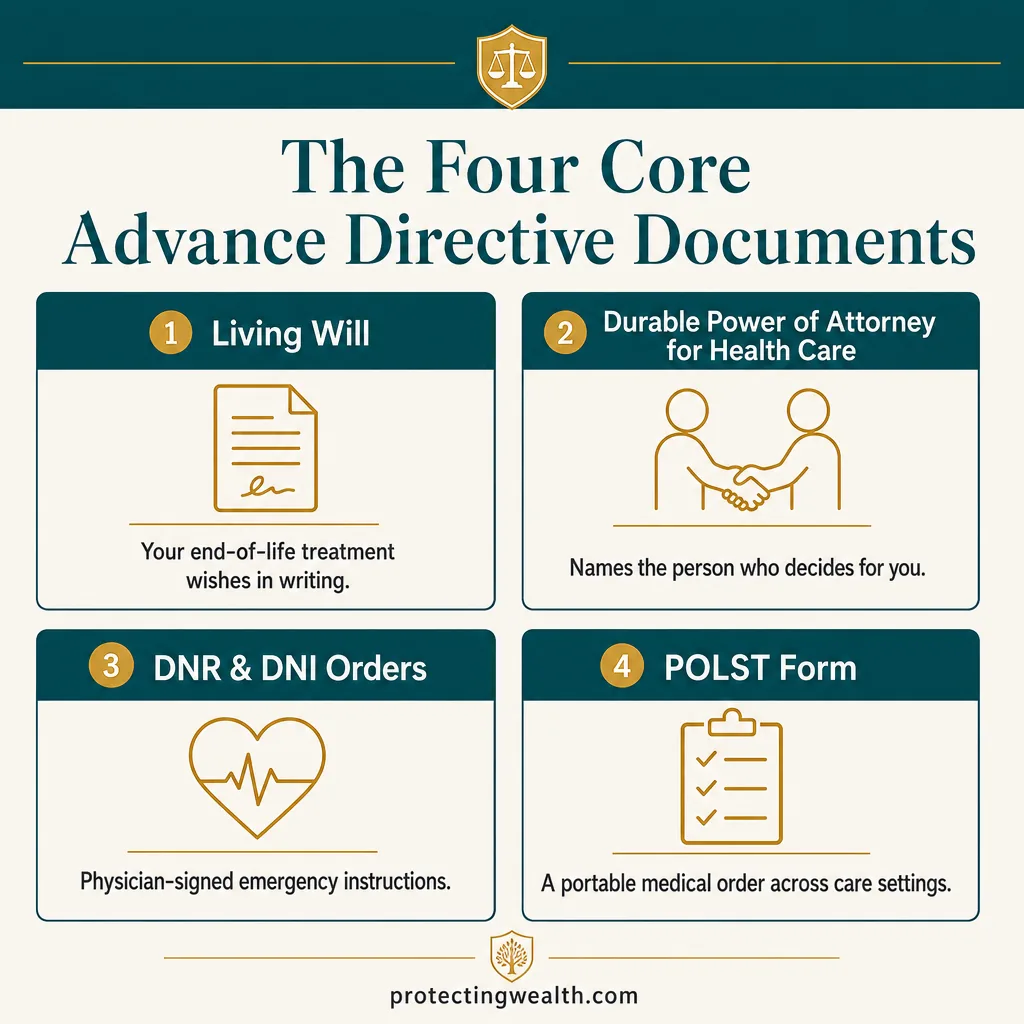
The four core advance directive documents and what each one does.
Every Type of Advance Directive and What Each One Does
1. The Living Will (or Declaration Concerning Death-Prolonging Procedures in Missouri)
Missouri calls it a “declaration concerning death-prolonging procedures,” not a living will, and that distinction matters more than most people realize. This written legal document activates only when your condition is terminal and you can no longer participate in your own health care decisions. Arkansas uses broader language under its Healthcare Decisions Act, giving residents more flexibility in what their declaration can address. Both states require witness signatures to make the document legally valid.
2. The Durable Power of Attorney for Health Care
This is the document I tell every family to prioritize, because it names a specific person to make medical decisions on your behalf across a full range of situations, not just end-of-life scenarios. Your named health care agent, sometimes called a health care proxy or health care surrogate, steps in whenever your health care provider determines you lack decision-making capacity. Unlike a living will, the durable power of attorney for health care covers strokes, dementia, sudden accidents, and any medical situation your written instructions did not anticipate. It is the most flexible and protective tool in your advance care planning toolkit.
3. Do Not Resuscitate and Do Not Intubate Orders
A DNR order and a DNI order are not patient-drafted forms; they are physician orders that must be signed by a licensed doctor and entered into your medical record. Your living will may express that you do not want CPR, but without a formal out-of-hospital DNR in place, medical staff in an emergency room are legally required to attempt resuscitation regardless. In Missouri and Arkansas, out-of-hospital DNR forms follow specific state requirements and must travel with you to every new health care facility.
4. POLST Forms
A 77-year-old farmer from just outside Bentonville, Arkansas, had both a living will and a durable power of attorney for health care, but his family called in a panic one afternoon because paramedics were not following his documented wishes during a medical emergency at home. The problem was simple: he had no POLST form.
TheCDC reports that 65% of nursing home residents have at least one advance directive on file, yet POLST completion remains significantly lower in community settings. A POLST does not replace your other documents; it works alongside them to make sure your health care wishes are honored the moment they are needed most.
Table: Which Advance Directive Document Does What
Document
Who Creates It
When It Activates
What It Covers
Names a Decision Maker
Works Across Settings
Living Will
You (patient-drafted)
Terminal illness or permanent unconsciousness
Specific end-of-life treatment preferences
No
Yes, with state-specific forms
Durable Power of Attorney for Health Care
You (patient-drafted)
Any time you lack decision-making capacity
Full range of medical decisions
Yes
Yes
Health Care Power of Attorney
You (patient-drafted)
Physician certifies incapacity
Broad medical and treatment decisions
Yes
Yes
DNR Order
Physician-signed
Cardiac or respiratory arrest
Directs no CPR or resuscitation attempts
No
Requires re-filing at each facility
DNI Order
Physician-signed
Respiratory failure requiring intubation
Directs no mechanical ventilation
No
Requires re-filing at each facility
Out-of-Hospital DNR
Physician-signed
Emergency outside hospital setting
Directs EMS not to resuscitate
No
Portable across emergency settings
POLST Form
Completed with physician
Immediately, as a medical order
Life-sustaining treatment preferences in detail
No
Portable across all care settings
Five Wishes Document
You (patient-drafted)
Incapacity or terminal condition
Personal values, comfort, treatment, and relationships
Yes (in some states)
Recognized in most U.S. states
Missouri and Arkansas Have Different Rules, and Most People Get This Wrong
Missouri’s Specific Signing Requirements and What Happens When You Skip Them
Missouri requires that your advance health care directive be signed by two witnesses and a notary public, per§404.705 and §459.015 of Missouri statutes. Those witnesses cannot be related to you by blood or marriage, cannot be heirs to your estate, and cannot be financially responsible for your medical care. I have seen families present documents at hospitals that were signed but never notarized, and the health care facility had every legal right to set them aside. Getting the execution right the first time is not a technicality; it is the whole ballgame.
Arkansas Advance Directive Law and the Witness vs. Notary Option
Arkansas gives you a slightly more flexible path under the Arkansas Healthcare Decisions Act, found at§20-6-101 through §20-6-118. You can make your advance directive legally valid by signing before either two qualifying witnesses or a notary public, but not a combination that falls short of the full requirement. At least one of your witnesses must be a disinterested adult who is not related to you and does not stand to inherit from your estate. Arkansas also maintains no formal advance directive registry, so storing and sharing your documents correctly falls entirely on you and your family members.
How Missouri’s Pregnancy Exception Affects Your Document
This one catches people off guard, and I want to make sure it does not catch you off guard. Missouri law includes a pregnancy exception stating that any instructions to withhold or withdraw life-sustaining treatment will not be honored if the patient is pregnant. Arkansas carries a similar provision, and the living will document itself will be considered invalid in that circumstance under Arkansas law. If this applies to your situation or to someone in your family, it deserves a direct conversation with an estate planning attorney about how to address it properly in your documents.
What Changes When You Spend Significant Time in Both States
A couple in their early sixties split their time between their Springfield, Missouri home in the summers and their retirement property outside Bentonville, Arkansas, for the rest of the year. They had executed Missouri advance directives years earlier and assumed those documents would work across state lines. What they did not realize was that Arkansas health care facilities are far more likely to honor documents drafted under Arkansas state laws, and theNational Hospice and Palliative Care Organization specifically recommends that anyone spending significant time in more than one state prepare state-specific documents for each location.
According to2024 Census Bureau data analyzed by America’s Health Rankings, both Missouri and Arkansas have senior populations above the national average, at 18.7% and 18.2% respectively, meaning a large share of residents in these two states are exactly in the age group where this planning becomes most urgent. I always recommend that families with ties to both states work with an attorney licensed in all relevant jurisdictions, and with five-state licensure covering Missouri, Arkansas, Kansas, Texas, and Virginia, this is something we help families sort out regularly.
Table: Missouri vs. Arkansas Advance Directive Requirements at a Glance
Cannot be related, an heir, or financially responsible for your care
At least one must be a disinterested adult, not a relative or heir
Pregnancy Exception
Yes, directives to withdraw treatment not honored during pregnancy
Yes, living will is invalid if patient is pregnant
Artificial Nutrition Restriction
Standard living will cannot direct withdrawal of feeding tube
Can be addressed in the advance directive with proper language
State Registry
No formal registry
No formal registry
Agent Authority Revoked by Divorce
Yes, automatically upon filing
Yes, automatically upon filing
Out-of-Hospital DNR Available
Yes, state-specific form required
Yes, must include physician signature
Choosing the Right Health Care Agent Is the Most Consequential Decision in This Whole Process
What a Health Care Agent Is Actually Responsible For
Your health care agent, also called a health care proxy or health care surrogate, is the person your durable power of attorney for health care legally authorizes to make medical decisions on your behalf. Once your health care provider certifies that you lack decision-making capacity, your agent steps in and speaks directly with your medical team, reviews your records, and makes real-time calls about your treatment. That includes decisions about surgery, hospitalization, comfort care, artificial nutrition, and in some circumstances, withdrawing life-sustaining treatment. This is not a ceremonial role; it carries genuine legal weight.
Qualities That Separate a Good Agent from a Dangerous Choice
A retired contractor from Joplin in his mid-seventies once told me he had named his oldest son as his health care agent simply because he was the eldest. When we talked it through, it became clear that son lived four states away, struggled emotionally with medical settings, and had never once discussed his father’s health care wishes with him. We ended up naming a younger daughter who lived locally, worked calmly under pressure, and had been present for every one of his medical appointments for years. Before you sign anything, I want you to run your chosen agent through this honest checklist:
Availability: Can this person realistically be reached and physically present during a medical crisis?
Emotional steadiness: Will they advocate for your wishes even when other family members push back?
Alignment with your values: Do they genuinely understand what quality of life means to you?
Willingness: Have they actually agreed to take this on, and do they understand what it involves?
Asystematic review in Annals of Internal Medicine found that at least one-third of surrogate decision makers experienced significant emotional burden when making medical decisions for a loved one, with stress and guilt lasting months or even years in some cases.
The Conversation You Must Have Before Signing Anything
Naming someone as your health care agent without having a real conversation first is like handing someone the keys to your house without telling them where anything is. Dr. Jennifer Ritzau, Director of Palliative Care at HopeHealth,puts it plainly: “If there hasn’t been this planning process, family members can be thrust into an uncomfortable spot of having to decide on medical care for somebody they love very much.”
Your agent needs to know your feelings about life-sustaining treatment, pain management, and what an acceptable quality of life looks like to you personally. That conversation is not a one-time event; it should happen again whenever your health or your values shift in any meaningful way.
What Happens to Your Family If You Die Without Advance Directives and Living Wills in Missouri or Arkansas
How State Law Decides Who Speaks for You
When you become incapacitated without any advance directive in place, Missouri and Arkansas both default to a legally established hierarchy of decision makers. That hierarchy typically moves from spouse to adult children to parents to siblings, in that order. The problem is that state law does not know your family. It does not know which adult child you trust, which sibling understands your values, or whether your estranged relative is suddenly first in line to make life-altering medical decisions on your behalf.
Consequences of Family Disagreements Without a Document
Alandmark study published in the New England Journal of Medicine found that 42.5% of older adults required surrogate decision making near the end of life, and among those who had living wills requesting comfort care, 97.1% received it. Without documentation, those outcomes drop sharply and family conflict rises just as fast. I have watched close families fracture completely over medical decisions that a properly executed advance directive would have settled in advance, quietly and clearly. Asone attorney cited in a 2026 U.S. News report put it, without clear written guidance, loved ones are often forced to guess, argue, or seek court intervention.
When Courts Get Involved and What That Looks Like for Your Loved Ones
Two sisters from the Kansas City area, both in their fifties, brought their disagreement about their mother’s medical care directly into a Missouri courtroom after she suffered a severe stroke with no advance directive on file. What followed was a guardianship proceeding that took months, drained family savings, and left their mother’s care in legal limbo during the entire process. Guardianship, which Missouri statutes refer to as lifetime probate, is exactly what advance care planning exists to prevent. It is expensive, emotionally exhausting, and entirely avoidable when the right legal documents are in place before a medical crisis strikes.
What Your Advance Directive Must Spell Out to Actually Be Honored by Doctors
1. Life-Sustaining Treatment Preferences That Need to Be Explicit
Vague language in an advance directive is almost as unhelpful as having no document at all. Medical professionals need specific, unambiguous instructions to act on your health care wishes with confidence during a medical crisis. A2025 MDPI Healthcare study from Indiana University School of Medicine reported that the national average advance directive completion rate among older adults in primary care sits at 46%, yet many completed documents lack the clinical specificity that medical staff actually need. Your document should address each of the following treatments by name:
Cardiopulmonary resuscitation (CPR) and use of an automated external defibrillator
Mechanical ventilation and breathing assistance
Kidney dialysis
Antibiotics for life-threatening infections
Blood transfusions and surgical intervention
Hospitalization versus comfort-focused care at home
2. Nutrition, Hydration, and the Feeding Tube Decision Missouri Courts Have Weighed In On
This is one of the most emotionally charged decisions families face, and Missouri has a specific legal history around it that every resident deserves to know. Missouri statutes explicitly restrict a standard living will from directing the withdrawal of artificially supplied nutrition and hydration, meaning a feeding tube.
To address this preference, you need an expanded advance directive drafted with clear and convincing language that satisfies Missouri’s legal standard. I walk every client through this distinction carefully, because a document that does not address artificial nutrition the right way in Missouri may not be honored the way you intended.
3. Pain Management, Comfort Care, and Organ Donation Instructions
A woman in her late sixties from Springfield told me during our first meeting that her single biggest fear was dying in pain while machines kept her body going. That is an incredibly common and completely valid concern, and it belongs in your advance directive by name. Your document should explicitly authorize your medical team to prioritize pain management and comfort care even when curative treatment has been set aside. If anatomical donation or organ donations align with your values, those instructions belong in your document as well, along with a note to your health care agent so there is no confusion in the moment.
4. Religious and Personal Values That Should Appear in the Document
Medical professionals treat the document in front of them, and the more your advance directive reflects who you actually are, the better your care team can serve you. I encourage clients to include a brief statement of their personal values, faith tradition, and what quality of life genuinely means to them.
Aging with Dignity, the organization behind the widely used Five Wishes document, has long advocated for this values-based approach to advance care planning because it gives medical personnel and family members the human context behind every clinical decision. Your beliefs about mental health treatment, electroconvulsive treatment, psychotropic medicine, and other sensitive interventions can also be addressed here when relevant to your situation.
How to Store, Share, and Keep Your Advance Directive from Being Ignored in a Crisis
Where Your Original Document Needs to Live
Do not put your advance directive in a safe deposit box. I say this to almost every client because it is one of the most common mistakes families make, and it is genuinely well-intentioned. A document locked inside a bank vault is completely inaccessible on a Saturday night when paramedics are standing in your living room. Keep your original at home in a clearly labeled, easily accessible location, and store a scanned digital copy on your phone or a secure cloud service your health care agent can reach from anywhere.
Who Must Receive a Copy Before Any Medical Event Occurs
TheHospice Foundation of America reports that most Americans prefer to die at home, yet only about 30% do, and inaccessible advance directives are a contributing factor to that gap. Your primary care doctor needs a copy in your medical record before any acute health issue arises, not after. Your health care agent, any alternate agents, and the key family members who might be present during a medical crisis all need their own copies as well. If you spend time at a health care facility, assisted living residence, or any part of a support team, those healthcare providers need the document on file too.
The Wallet Card That Can Make a Life-or-Death Difference in an Emergency
A 71-year-old retired postal worker from Bentonville had done everything right. He had a properly executed Arkansas advance directive, a named health care agent, and copies distributed to his primary care doctor and his two adult children. But when he collapsed at a gas station one Tuesday morning, the paramedics who responded had no idea any of those documents existed. His daughter was forty minutes away and unreachable for the first critical window of his care.
TheAmerican Hospital Association recommends carrying a wallet-sized card indicating that you have advance directives, naming your health care agent, and noting exactly where your documents can be found. That small card, tucked behind your driver’s license, can give medical personnel the information they need to honor your health care wishes in the first moments of an emergency when every second counts.
Your Advance Directive May Have an Expiration Problem
Life Events That Make Your Current Documents Outdated Overnight
An advance directive does not carry an official expiration date, but life has a way of making old documents dangerously out of step with your current reality. APMC study drawing on Health and Retirement Study data from 3,675 older adults found that overconfidence about one’s own health delayed living will completion by an average of 7.25 months, and the same thinking keeps people from updating documents they already have. Review your advance directive any time one of these life events occurs:
A new decade of life
Death of your named health care agent
Divorce or remarriage
A new diagnosis or significant change in your health
Moving between states, such as between Missouri and Arkansas
A major shift in your personal values or religious beliefs
Your documents should reflect who you are today, not who you were when you first signed them.
Divorce Automatically Revokes Your Agent’s Authority in Missouri
This is one of the most important and least discussed legal facts in Missouri estate planning, and I want you to hear it clearly. Under Missouri law, filing for divorce automatically revokes your former spouse’s authority as your named health care agent under your durable power of attorney for health care. Arkansas carries a nearly identical provision. That means the moment divorce proceedings begin, you may have no valid health care agent at all until you execute a new document naming someone else. Do not wait for the divorce to finalize; update your advance directive the same week you file.
Building a Review Schedule That Actually Works
Charles Sabatino of the American Bar Association recommends reviewing your advance directive using the “Five D’s”: a new decade of life, death of a loved one, divorce, a new diagnosis, and medical decline. I add a sixth one of my own: any time you move to or spend significant time in a new state, because Missouri and Arkansas have different legal requirements that affect your documents.
A 59-year-old business owner from Joplin who had last updated her advance directive in her early forties came to us after her mother’s death made her rethink everything, and we found that three of her four named agents were no longer appropriate choices. Building an annual check-in with your estate planning attorney, the same way you schedule a medical checkup, is the simplest and most reliable way to make sure your advance care planning never quietly falls out of date.
Families Across Missouri and Arkansas Protect These Decisions with Help from The Law Offices of Christopher W. Dumm
Why a State-Specific Attorney Makes a Difference in Missouri and Arkansas Planning
Missouri and Arkansas have meaningfully different legal requirements for advance directives, and a generic document drafted without state-specific knowledge can fail at exactly the wrong moment. I have been licensed in Missouri and Arkansas for over 27 years, and I have seen firsthand how state laws around witness signatures, notarization, pregnancy exceptions, and artificial nutrition create real consequences for families who used one-size-fits-all forms.
TheNational Hospice and Palliative Care Organization specifically recommends state-specific advance directive forms for anyone spending significant time across state lines. When your family’s health care decisions are on the line, state-specific legal knowledge is not a luxury.
The LIFE Program and How Your Documents Stay Current as Life Changes
One of the things I hear most often from new clients is that they signed their advance directive years ago and simply forgot about it. That is exactly the problem theLIFE Program was built to solve. As a LIFE Program member, your estate planning documents are reviewed and updated regularly, you receive educational workshops on legal changes affecting your health care wishes, and you have ongoing access to our team when life shifts in ways that affect your planning.
As one longtimeclient told us, “He continues to educate us and update us. We have great trust in him.” LIFE Program membership includes these for your advance care planning:
Regular document reviews triggered by major life events
Notification when Missouri or Arkansas state laws change in ways that affect your documents
Educational workshops covering advance directives, durable power of attorney for health care, and estate planning updates
Priority access to our team when an acute health issue or family medical crisis arises
Peace of mind that your health care wishes will never quietly become outdated
What a Free Consultation with Chris Dumm Looks Like and What to Bring
I want you to walk into our offices in Joplin, Springfield, or Bentonville knowing exactly what to expect, because a first consultation should feel like a conversation, not an interrogation. We will talk about your family, your health care wishes, your values, and the specific legal requirements that apply to your situation across Missouri and Arkansas.
To make the most of our time together, bring any existing legal documents you have, a list of people you are considering as your health care agent, and any questions your family has raised about end-of-life care or advance care planning. You will leave with clarity, a clear next step, and the kind of peace of mind that comes from knowing your family is protected. Call us at (417) 623-2062 orbook online now to schedule your free consultation today.
Frequently Asked Questions
1. Can my health care proxy make decisions about mental health treatment on my behalf?
Your health care power of attorney can grant your healthcare proxy authority over mental health treatment decisions, but you should spell this out explicitly in your document. Some families also address electroconvulsive treatment and psychotropic medicine preferences directly to remove any ambiguity for medical professionals.
2. What is a HIPAA Authorization and does it belong with my advance directive?
A HIPAA Authorization allows your named health care agent to access your medical records and communicate with your health care professional about your care. I recommend including it alongside your advance directive forms so your agent is never blocked from getting the information they need during a crisis.
3. What is the Patient Self-Determination Act and how does it affect me as a Missouri or Arkansas resident?
ThePatient Self-Determination Act, passed by Congress in 1990, requires Medicare-certified health care facilities to inform you of your right to create advance health care directives upon admission. That means every hospital, nursing home, and qualifying health care facility in Missouri and Arkansas must ask you about your documents and honor them.
4. Does my advance directive cover anatomical donation and organ donations?
Your living will or expanded advance directive can absolutely include instructions for organ donations and anatomical donation. I encourage clients to document these healthcare preferences clearly so their medical team and health care agent are not left guessing during an already difficult moment.
5. Can a social worker help me complete my advance directive without an attorney?
A social worker or member of your advance health care team can help you think through your healthcare wishes and access legal forms, and organizations like theAmerican Association of Retired Persons offer free instruction links and state-specific resources. That said, an estate planning attorney ensures your documents meet Missouri or Arkansas legal requirements precisely.
6. What is an Out-of-Hospital Do-Not-Resuscitate Form and do I need one in addition to my advance directive?
An Out-of-Hospital Do-Not-Resuscitate Form is a physician-signed medical order that tells emergency medical personnel not to attempt resuscitation outside of a hospital setting. It works alongside your advance directive and is especially important if you have strong preferences about where and how end-of-life medical treatment is administered.
7. Are there any organizations which provide advance directive resources?
Organizations including theAmerican Cancer Society,National Cancer Institute, and Prisma Health all provide advance care planning resources and guidance for patients managing serious illness. For legally binding documents that satisfy Missouri or Arkansas state laws, however, working directly with a licensed estate planning attorney in your state is always the most reliable path.
8. What does the Conversations Project recommend about advance directives?
TheConversations Project provides free guides specifically designed to help families discuss healthcare wishes before a medical crisis forces the conversation. I always tell clients that having the talk early, while everyone is calm and healthy, is one of the greatest family benefits any advance care planning process can deliver.
9. Does my advance directive automatically transfer if I move from one state to another?
It may be recognized, but it is not guaranteed, and the legal requirements for valid advance health care directives differ meaningfully between the two states. Rather than hoping your existing medical directive crosses state lines without issue, I recommend executing fresh, state-specific documents for whichever state becomes your primary residence.
Conclusion
Good planning now prevents crisis later. Advance directives and living wills are not paperwork exercises; they are the most protective gift you can give your family. At The Law Offices of Christopher W. Dumm, we have spent 27 years helping Missouri and Arkansas families turn confusion into clarity and worry into genuine peace of mind. We know your family by name, not a number, and we are ready to help you build a plan that actually holds up when it matters most.
Schedule Your Free Consultation Today.