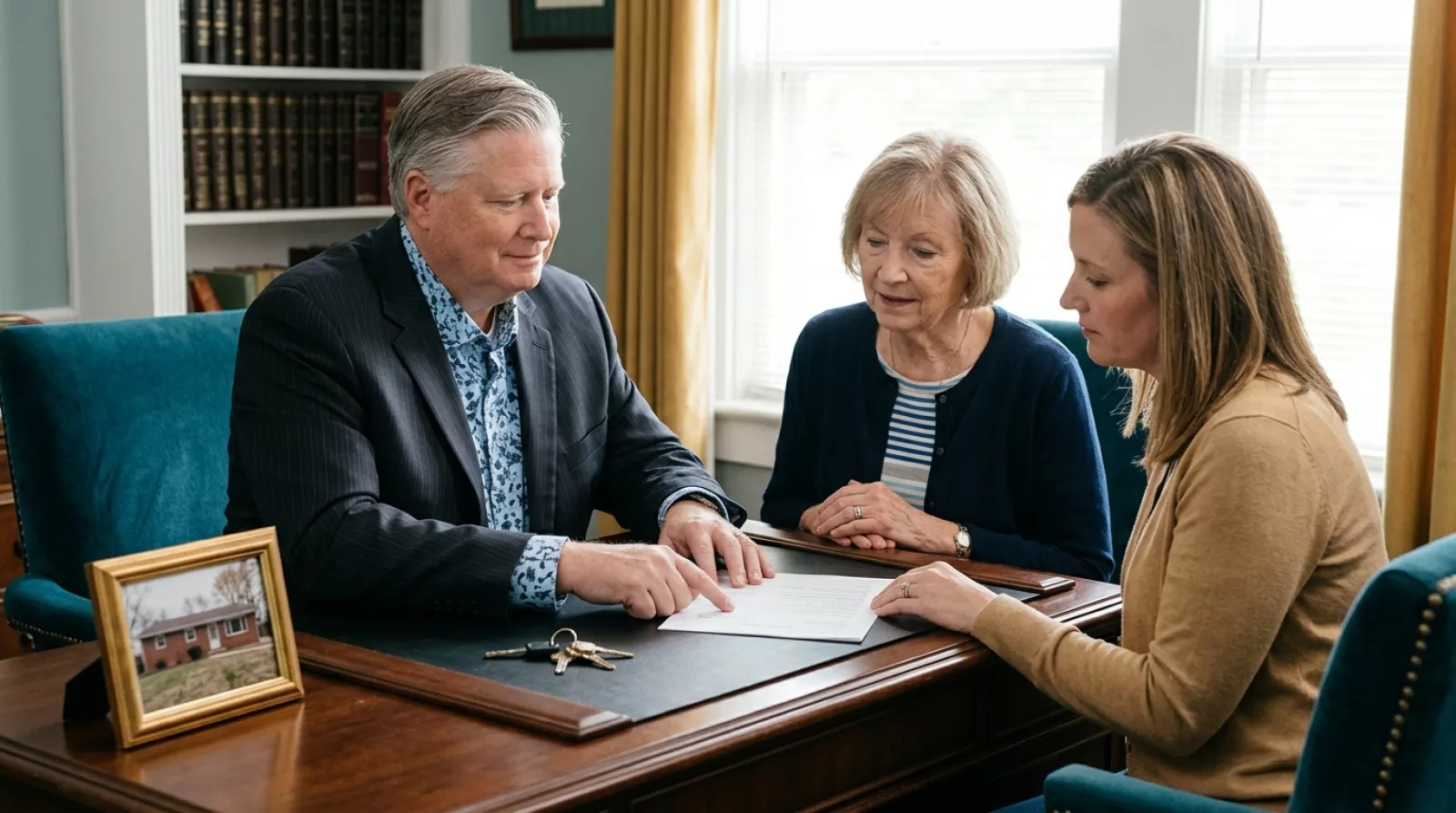
Adding a child to a deed can skip probate, but it also gives them a share now. Learn what changes in Missouri and Arkansas, and the simpler tools to use.

What You’re Really Paying For When Your Lawyer Uses AI
Lately, more of my clients are asking me a version of the same question. If your firm is using artificial intelligence to help with research, drafting, and organizing a file, does that mean you are doing less of the work? And if the computer is handling more of it, shouldn’t the plan cost less?
It’s a fair question, and I’m glad people ask it. But it rests on an assumption I want to walk through with you, because the answer says a lot about what estate planning actually is.
You don’t hire our firm to produce pages of legal language.
You hire us for judgment, for experience, for advice you can act on, and for a plan built around your family, your property, your business, your tax picture, and what you want to happen down the road. AI can make a good lawyer faster. It cannot take over a lawyer’s job of understanding your family, finding the real issue, making the call, and standing behind the result. That difference is the whole point, so let me explain how I think about it.
Dumm Takeaways
- Our firm uses AI to organize meeting notes, compare documents, check names and dates, and test a plan against what-if situations.
- AI can be wrong, miss state-specific law, or produce language that doesn’t fit your family, so a lawyer verifies the law and reviews every final document.
- What you pay for is judgment, experience and accountability, not the time it takes to type a document.
- A document isn’t a plan. A trust no one funded, or a will that can’t reach your retirement accounts, can fail even when the paperwork looks right.
- If your plan is a few years old, it’s worth checking that it still fits your life.
I have watched this kind of change before
When I began practicing law, it was still common for some lawyers to dictate a document to a secretary. She typed it, printed it, and handed it back. We marked our changes by hand, and then the whole thing got typed again. Even a small revision could eat up real staff time, and preparing several versions of a complicated trust was slow and expensive.
Then firms brought in computers and word processing. That technology took most of the mechanical labor out of producing a document. We could revise a provision in seconds, reorganize a draft, compare versions, catch inconsistencies, and keep libraries of carefully written language we trusted.
Word processing did not put lawyers out of work. It freed us to spend more time on the parts of the job that actually needed a lawyer: gathering the facts, weighing the options, talking things through with the family, and improving the plan.
In estate planning, I think that shift mattered more than most people realize. Before those tools, a truly customized plan could become cost-prohibitive simply because of the hours required to draft, revise, and reproduce every provision. Many families ended up with fairly standardized documents because deep customization was too labor-intensive to be practical. Computers changed that and made it economically possible to prepare more detailed, personal plans than earlier generations of lawyers could efficiently produce.
I see AI as the next step in that same story.
The real skill is knowing when to use it, and when not to
Some people call it “AI intuition,” which is just a name for knowing which parts of a job a tool can improve and which parts have to stay human.
AI is genuinely good at certain things. It can organize information, compare language across documents, flag possible inconsistencies, build checklists, summarize a mountain of material, and help structure a first draft. Those are useful capabilities, and a firm should put them to work.
But there is a line, and it really matters. AI does not know your family.
It doesn’t know why one of your children should serve as trustee and another should not. It doesn’t feel the tension between two siblings unless someone says it out loud. It doesn’t know that a beneficiary is wonderful with money but easily swayed by a spouse, or that the family farm carries meaning for you that has nothing to do with its appraised value. It doesn’t sit across the table from a husband and wife and quietly notice that they want different things for the years ahead. It doesn’t catch the pause before someone answers a hard question, and it can’t reliably tell when the problem a client describes is not the problem that actually needs solving.
And here is the part that matters most: AI is not responsible for the advice. I am.
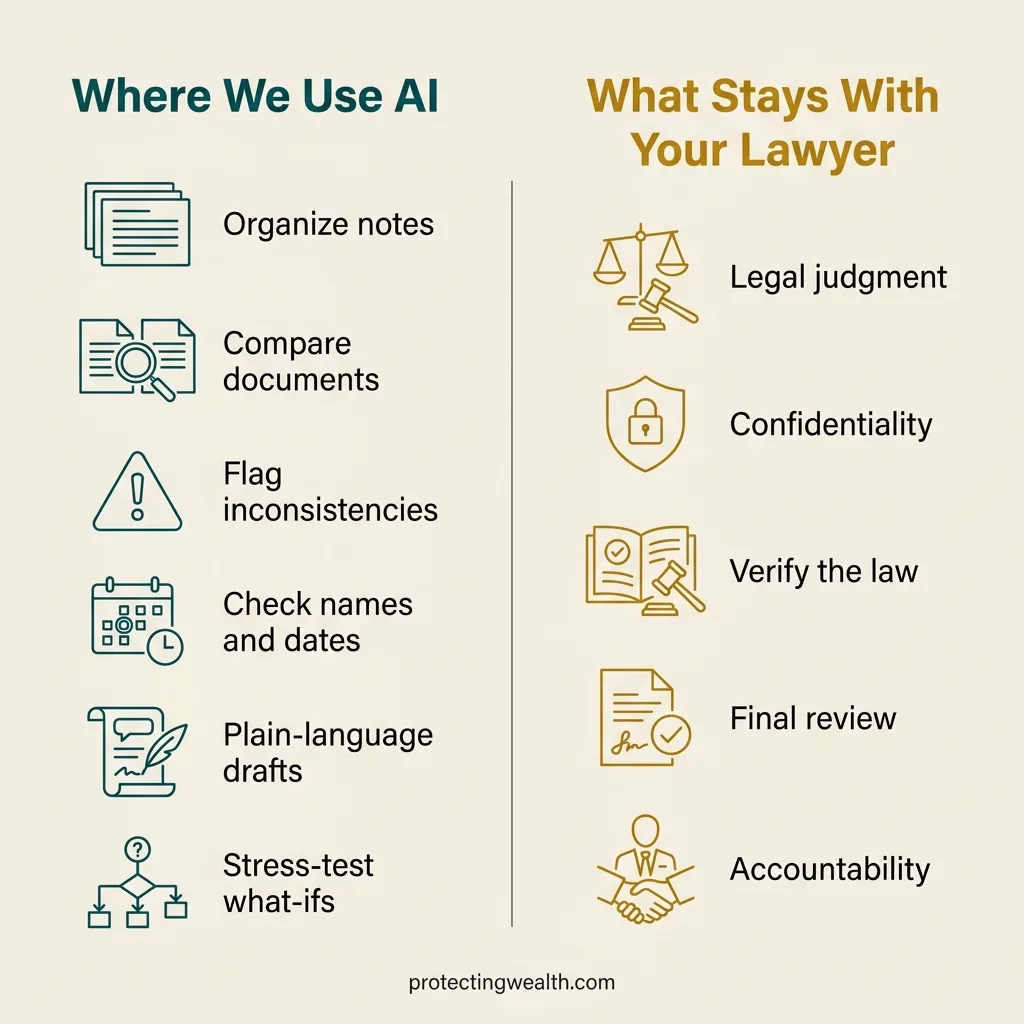
What we use AI for, and what we never hand to it
A responsible firm should use AI where the technology genuinely performs well. In our practice, that means using it to help organize notes from a client meeting, spot missing facts we need to follow up on, compare provisions across a set of documents, double-check names, dates, and defined terms, turn a dense legal concept into plainer language for you, and test a plan against different what-if situations. That last one is worth unpacking.
I can use technology to look at how a plan would hold up if a beneficiary passes away before you, becomes disabled, goes through a divorce, runs into creditor trouble, or comes to rely on public benefits. I still have to decide which of those risks are worth planning around and how to handle them. But the technology lets me examine your plan from more angles than I could have worked through by hand on my own. That means a more thorough review for you, not a thinner one.
Now the other side. The fact that AI can produce legal-sounding language does not mean it should be trusted to make legal decisions. Its output can be incomplete, internally inconsistent, or simply wrong. It can cite cases that do not exist. It can miss state-specific law, and since we are licensed in Missouri, Kansas, Arkansas, Texas, and Virginia, I can tell you those differences are real. Even when the language is technically correct, it may be wrong for your particular situation.
So we do not type a few facts into a machine, accept whatever appears, and send it to you. A lawyer decides what information is appropriate to place into any tool, protects your confidentiality, verifies the law, and personally reviews every substantive recommendation and every final document. AI can help with the work but it never is left in charge of it.
So what are you actually paying for?
When we use these tools the right way, you are not paying for the number of keystrokes it took to produce your documents.
You are paying for a lawyer who knows which questions to ask, who recognizes an issue you didn’t know existed, and who understands how tax law, trust law, probate, Medicaid rules, beneficiary designations, business succession, and everyday family dynamics all fit together. You are paying for judgment built over decades of watching what works, what fails, and what quietly starts family fights years later. And you are paying for a professional who is accountable for the result.
That last point isn’t trivial. AI does not carry malpractice insurance. It owes you no professional duty. It will not appear in court, it will not sit with your family after a death, and it will not answer for a provision that fails. Your lawyer will.
A document is not a plan
You can already find inexpensive legal forms online, and AI will make it even easier to generate wills, trusts, and powers of attorney. But the availability of cheap documents does not remove the need for legal advice, because a document is only one piece of a plan.
A story the AI educator Paul Roetzer shared on his show recently makes this point better than I can. Roetzer runs one of the best-known AI education companies in the country, so putting these tools to work is his whole profession. This spring his father received a terminal diagnosis with little time left and no estate plan in place. Roetzer did what he does best. Racing the clock, he used AI to help pull the documents together, and he did not simply take its word for it. He went back more than once to ask whether the process was right, and each time it told him yes. His father passed about three weeks later, and only then did he learn that the process had skipped one fundamental step, one that had to be handled before his father died and could no longer be fixed. The tool, he said, got him most of the way there, and the small piece it missed was the part that mattered most. A probate attorney, in his words, would have caught it in seconds. His takeaway was simple: the humans are still needed.
That is exactly the part I worry about for the families I serve. A set of documents can look finished and still miss the one step that makes it work, and a tool will rarely tell you which step that is, because it does not know what it does not know. Someone who has guided families through this for decades usually sees it on sight.
A trust can be beautifully written and still fail because no one ever moved your assets into it. A will can be perfectly valid and still have no control over your retirement accounts or jointly owned property. A power of attorney can be thorough and still get turned away by a particular bank. Special-needs language can read impressively and still put a loved one’s benefits at risk. A document can even create a tax result you never intended or hand authority to the wrong person.
My job is to connect the documents to your actual life: what you own, how it is titled, who should receive it, who should manage it, what tax or creditor concerns may exist, and what should happen when your circumstances change. AI can help me analyze parts of that. It cannot do the work itself.
The human part becomes more important, not less
As polished, AI-generated content becomes ordinary, human judgment becomes more valuable, not less. When almost anyone can produce ten pages of legal-sounding language, the question is no longer “can someone generate a document?” It becomes “is this the right document, for the right family, under the right law, built to reach the right result?”
Answering that takes judgment. It takes knowing what matters and what doesn’t, telling a theoretical worry apart from a practical risk, and recognizing when a simple solution is enough and when a situation calls for something more careful. It also takes empathy. Estate planning is rarely just about transferring property. It is about protecting a surviving spouse, providing for children, keeping a business or a farm in the family, planning for the possibility that you cannot make decisions for yourself, and sparing the people you love from conflict during an already difficult time. Those are human concerns, and they call for a human relationship.
Our approach
I don’t think a firm should be proud simply because it uses AI. It should be able to tell you plainly how it uses the technology, how it protects your information, how the work gets reviewed, and where human judgment stays in charge.
Ours is straightforward. We use technology wherever it makes the work more accurate, better organized, more consistent, and more thorough. We do not let it stand in for professional judgment, real conversation, confidentiality, or accountability. Used well, AI doesn’t shrink the value of your lawyer. It lets a good lawyer spend more time on the work only a person can do, which means you get more from us, not less: more analysis, more clarity, more attention to the details, and more time focused on what actually matters to your family.
If you have questions about how we work, or your plan is a few years old and you are not sure it still fits your life, I would be glad to talk it through with you.
Please note: This article is for general educational purposes only and is not legal advice. Reading it does not create an attorney-client relationship. Every family’s situation is different, and past results do not guarantee future outcomes. For guidance about your own circumstances, please speak with a licensed attorney.

Related Posts