You remarried a few years back. You each brought children with you, two households became one, and somewhere in a drawer sits a will that one of you signed during a first marriage. Most of what gets written about estate planning blended families stops right about there, with a friendly suggestion to talk it over and update your paperwork.
What usually goes unsaid is that the same couple, with the same children and the same house, gets two very different answers depending on whether they live in Joplin or in Bentonville. Missouri and Arkansas don’t share a rulebook. They diverge on what a surviving spouse receives, on what the children receive, and on whether a couple can still sign an agreement after the wedding.
So this page does the thing the other pages skip. Below are the actual Missouri rules and the actual Arkansas rules, set side by side, along with the paperwork worth pulling out of the file cabinet first. I’ve been teaching families this material since 1994, and the state line is where the surprises live.
Start Here: What to Update First After You Remarry
The first useful move after remarrying isn’t rewriting the will. It’s pulling the beneficiary forms, because those accounts pay out to whoever is named on them no matter what a will says. A will drafted last month can’t reach an account that already has instructions attached.
Here is the order I walk people through, most urgent first:
Employer retirement plans. The 401(k), 403(b), or pension beneficiary form. What HR has on file is what controls, and it isn’t always what anyone remembers signing.
IRA beneficiary forms. These are governed differently than employer plans, and they’re a common place a former spouse is still named years later.
Life insurance. Both an individually bought policy and any group coverage through work, which people forget they have.
Bank and brokerage accounts. Payable-on-death and transfer-on-death designations sit quietly on these and pass the money outside probate.
The deed to the house. Not only whose name is on it, but how the title is held, because that determines whether the house passes by the deed or by the will.
Durable power of attorney and health care directive. These name who speaks for you and who decides on medical care if you can’t. A durable power of attorney is simply a document that keeps working after you lose capacity.
The will, or the revocable living trust, last. It only controls whatever the first six items left behind.
That list is triage. The plan comes after, once a couple has settled who they want taken care of and in what order.
Do Stepchildren Inherit? Only If You Say So
A stepchild you never legally adopted inherits nothing from you by default, in Missouri and in Arkansas alike, no matter how many birthdays and ball games you showed up for. Both states run inheritance down the line of descendants. Missouri’s rules of descent and distribution, RSMo 474.010, send the estate to children and their descendants, and the Arkansas table of descent, Ark. Code 28-9-214, starts in the same place. A stepchild isn’t on that line unless adoption put them there.
That default is only half the problem. The other half is the language sitting in documents people already signed:
“My children” in a will drafted during a first marriage. Written then, it meant the children who existed then.
“My descendants” or “my issue.” Both are legal shorthand for a bloodline and adopted children, which quietly leaves a stepchild out.
Per stirpes language that was never revisited. It means a deceased child’s share drops down to that child’s own children, and it says nothing about anyone else.
Class gifts, meaning a gift to a group rather than to named people. The group gets defined by law, not by a household.
My own drafting habit here is unglamorous. I name human beings by name, and I say out loud in the document whether stepchildren are included or excluded. Silence tends to get read against the person who isn’t on the family tree, and the people left arguing about it are the same people you hoped would still eat Thanksgiving dinner together.
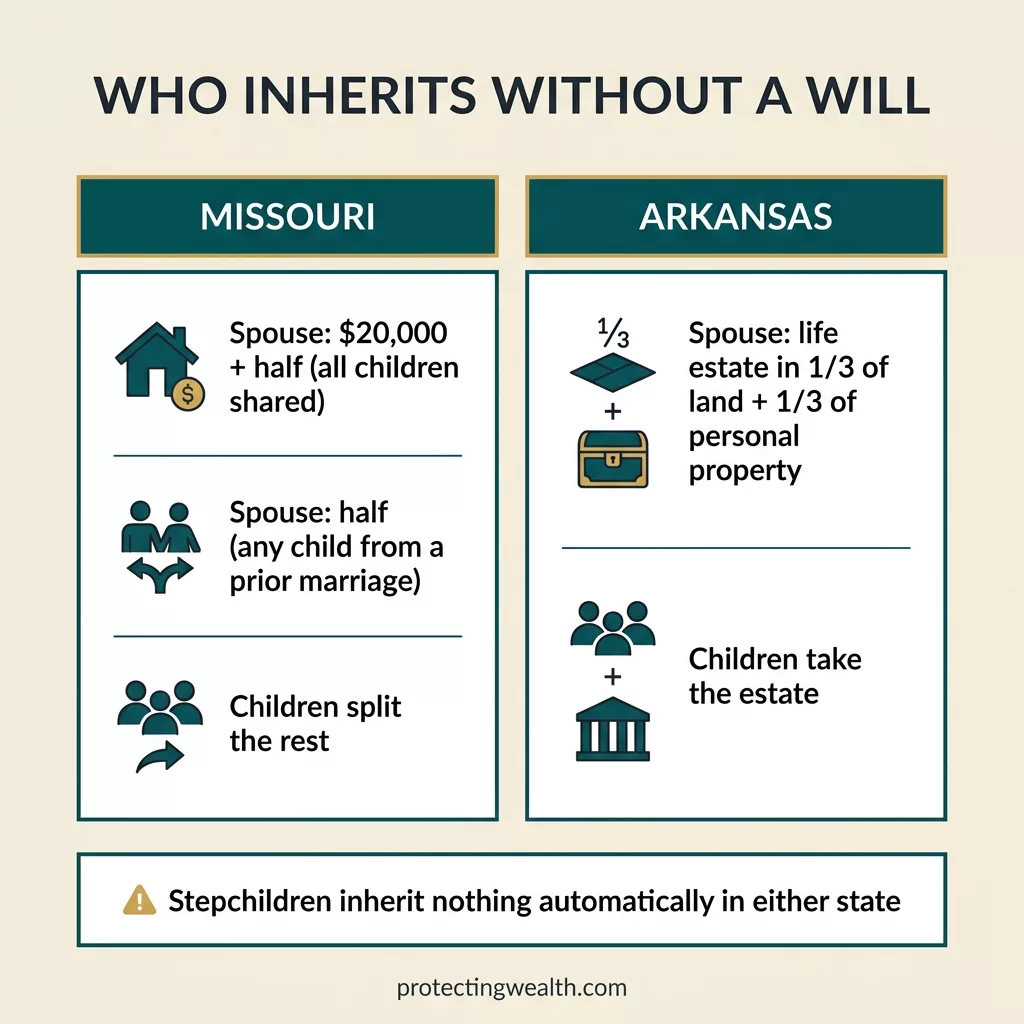
What a surviving spouse receives without a will: Missouri and Arkansas answer differently.
What Happens If You Never Write a Plan: Missouri vs. Arkansas
Without a plan, the state writes one for you, and these two states write very different plans for the same family. Under RSMo 474.010, a Missouri surviving spouse takes the entire intestate estate when there are no surviving descendants. When every surviving child is also the spouse’s child, the spouse takes the first $20,000 of the intestate estate plus one half of the balance.
Then comes the part that catches remarried couples. When any surviving child is not also a child of the surviving spouse, the Missouri spouse takes one half and the preference off the top no longer applies. A second marriage is precisely the case that loses it. The remainder passes to the children, or their descendants, in equal shares.
Arkansas doesn’t work that way at all. It still runs on dower and curtesy, the old terms for the share a widow or widower takes off the top. Under Ark. Code 28-11-301, a surviving spouse with a child or children is endowed of one third of the lands for life, meaning a life estate rather than outright ownership. Under Ark. Code 28-11-305, that spouse is also entitled to one third of the personal estate in his or her own right.
The Arkansas children receive whatever is left. Ark. Code 28-9-206 defines the heritable estate as the portion that can pass by inheritance once dower, curtesy, homestead, and statutory allowances come off the top. Whether the children are also the surviving spouse’s children makes no difference in Arkansas, the very question Missouri turns on. An Arkansas spouse takes the whole heritable estate only where there are no descendants, and even then the share drops to fifty percent if the marriage lasted less than three years.
Situation
Missouri
Arkansas
No surviving children or grandchildren
Entire intestate estate to the spouse
Whole heritable estate to the spouse, or fifty percent if the marriage lasted less than three years
Every surviving child is also the spouse’s child
First $20,000 of the intestate estate to the spouse, plus half the balance
Dower or curtesy to the spouse; heritable estate to the children
Any surviving child is from a prior relationship
One half of the intestate estate, no preference off the top
No change from the row above; shared or not makes no difference
The house and land
Passes as part of the intestate estate under the shares above
Life estate in one third of the land, not ownership of it
What the children receive
The remainder, in equal shares
The heritable estate, what’s left after the spouse’s share and allowances
A situation I see often runs like this. A remarried couple in the Joplin area assumed the survivor would simply keep living in the house, and nobody had ever checked how the state fills in that blank.
If a Spouse Is Left Out of the Will: Elective Share vs. Dower
Both states give a surviving spouse a route to claim against the will, but the routes look nothing alike, and the same will can produce different results in Joplin and in Bentonville. In Missouri, RSMo 474.160 lets a surviving spouse elect to take against the will. That election is worth one third of the estate where the decedent left lineal descendants, and one half where there were none. A spouse who elects takes nothing under the will itself.
The question nobody answers is what that fraction gets measured against. RSMo 474.163 starts with what the decedent owned at death, reduced by funeral and administration expenses, exempt property, the family allowance, and enforceable claims. It then increases that figure by everything the surviving spouse already received from the decedent outside the will, such as trust interests, life insurance proceeds, and commuted pension values. The augmentation runs only to what the survivor received, so money routed outside probate to somebody else, like a policy naming first-marriage children, isn’t pulled into that base.
That gap is narrower than it looks. RSMo 474.150 treats a gift made in fraud of a spouse’s marital rights as recoverable and applies it toward the elective share. A conveyance of real estate made without the spouse’s joinder or written express assent is presumed fraudulent if the spouse survives.
Arkansas answers the same question with completely different machinery. Under Ark. Code 28-39-401, a surviving spouse may take against the will only after more than one continuous year of marriage. What that spouse then receives is dower or curtesy in the real and personal property as though the decedent had died without a will, plus homestead and statutory allowances, rather than a flat fraction of everything.
Question
Missouri
Arkansas
Can the surviving spouse claim against the will?
Yes, by electing to take against it
Yes, by electing to take against it, if the marriage ran more than one continuous year
How much?
One third of the estate with lineal descendants, one half without
Dower or curtesy as if there were no will, plus homestead and statutory allowances
Measured against what?
The probate estate after expenses and claims, increased by what the survivor received outside probate
The decedent’s real and personal property under the dower and curtesy rules
Minimum length of marriage?
The election statute sets none
More than one continuous year
Your Beneficiary Forms Outrank Your Will
Your will loses to the beneficiary form, in both states, on every account that has one. That’s the second and last rule on this page that applies identically on both sides of the line. Federal law then treats two retirement accounts that look alike very differently.
An employer plan covered by the federal pension law known as ERISA, like a 401(k) or a traditional pension, generally cannot pay anyone other than the current spouse unless that spouse signs off. 29 U.S.C. 1055 requires the spouse’s written consent, and that consent has to acknowledge what it gives up and be witnessed by a plan representative or a notary public. Federal law is doing the work there, whether or not anyone updated a form.
An individual retirement account carries no equivalent federal spousal-consent requirement. The form controls on its own terms, which means a beneficiary designation signed in 1998 still does exactly what it was told to do back then. Two accounts can sit on the same statement, both labeled retirement, and follow completely different rules.
The version I see most often runs like this. Someone remarries, sits down with a lawyer, updates the will carefully, and never touches the IRA opened long before, where a former spouse is still the named beneficiary. The will has nothing to say about it. The custodian pays the name on the form.
Employer plans (401(k), 403(b), pension). The current spouse generally wins absent written, witnessed consent.
IRAs. The named beneficiary wins, current spouse or not.
Life insurance. The named beneficiary wins. This is the first line item I ask about when someone tells me a divorce was finalized years ago.
Annuities. Contract terms and the named beneficiary control.
Payable-on-death and transfer-on-death accounts. The named person receives the account directly, outside probate.
The account people worry about least is usually the one that misfires.
Trusts That Keep Both Promises: How a QTIP Actually Works
A QTIP trust is designed to pay a surviving spouse income for life and then send whatever remains to the people named when it was set up. The initials stand for qualified terminable interest property, which is a mouthful for a fairly simple bargain. The spouse gets the benefit of the money while living. The children get what’s left.
The requirements in 26 U.S.C. 2056(b)(7) are what give the arrangement its spine. The surviving spouse must be entitled to all the income from the property, payable at least annually. No person may hold a power to appoint any part of that property to anyone other than the spouse during the spouse’s lifetime. The election is made by the executor on the estate tax return, and once made it’s irrevocable.
Each requirement is doing a job. The income right is what makes the arrangement fair to the spouse. The no-appointment rule is designed to keep a later remarriage or a persuasive relative from rerouting the children’s share.
This structure limits the surviving spouse’s control on purpose, meaning that spouse generally can’t spend the principal freely and can’t leave it to someone loved later on. There’s no version of this that gives both people everything they want. Some couples look at that plainly and decide the restriction costs more in resentment than it buys in certainty, and that’s a legitimate choice made with open eyes.
Before drafting, a couple has to settle four things:
Who serves as trustee, and whether that person can stay neutral between the spouse and the children.
What happens to the house specifically, including whether the spouse may sell it and move.
Whether the children receive anything at all before the surviving spouse dies.
Who pays for taxes, insurance, and upkeep on property the trust holds.
Prenuptial and Postnuptial Agreements: What Each State Requires
An agreement is how a couple sets their own rule instead of accepting the state’s, and the two states don’t put the same conditions on one. RSMo 474.220 permits the right of election to be waived before or after marriage, by a signed writing, after full disclosure of the nature and extent of that right, and for fair consideration. That “after marriage” language matters, because most people only think to ask about this once the wedding is behind them.
Arkansas addresses premarital agreements through Ark. Code 9-11-406. An agreement there is unenforceable if the party resisting it proves it wasn’t executed voluntarily. It also fails if that party proves it was unconscionable when executed and, before signing, got no fair and reasonable disclosure of the other’s property and obligations, did not waive disclosure in writing, and lacked adequate knowledge of those finances.
Requirement
Missouri
Arkansas
What the statute covers
Waiver of the spouse’s right of election
Premarital agreements
Timing
Before or after the marriage
Before the marriage, since this statute governs premarital agreements
Disclosure standard
Full disclosure of the nature and extent of the right waived
Fair and reasonable disclosure of property and obligations, unless waived in writing
What can undo it
A missing statutory element: no signed writing, incomplete disclosure, or no fair consideration
Proof it was not voluntary, or unconscionability paired with a disclosure failure
These agreements do get challenged. Disclosure is the part I would never economize on.
When Your Property Crosses the State Line
Real estate generally passes under the law of the state where the land sits, so a household in one state that owns ground in the other can have a single estate running under two sets of rules at once. Personal property, meaning accounts and belongings rather than land, is generally governed by the law of the state where a person lived at death.
The practical version looks like this. The Joplin house follows Missouri’s intestacy math, while forty acres across the line falls under Arkansas dower or curtesy. A surviving spouse could end up with half of the first and a life estate in a third of the second, which aren’t the same kind of thing.
Situations that trigger it around here:
A second home or lake place across the state line.
Inherited farm ground that stayed in the family after everyone moved.
A rental property bought where the numbers worked, not where you live.
Mineral, timber, or royalty interests on land you rarely visit.
A move that happened years after the documents were signed.
This is ordinary life along the Joplin, Neosho, Bentonville, and Bella Vista corridor, where people work in one state and own land in the other. Our firm keeps offices in Joplin and Springfield, Missouri, and in Bentonville, Arkansas, and I’m licensed in Missouri, Kansas, Arkansas, Texas, and Virginia. That’s the reason this question comes up in our offices.
Frequently Asked Questions
Does my stepchild inherit if I don’t have a will in Missouri?
No. A stepchild who was never legally adopted doesn’t inherit under Missouri’s rules of descent, which run to children and their descendants. How long a stepparent raised them doesn’t change that. For a stepchild to receive something, the documents have to name them.
In Arkansas, does my spouse get the house if I’ve children from a first marriage?
Not outright. Where there are surviving children, an Arkansas surviving spouse takes a life estate in one third of the land, a right to use it for life rather than ownership of it. Whether those children are also the spouse’s children makes no difference in Arkansas.
Can my new spouse override my will and take part of my estate?
In Missouri, yes. A surviving spouse may elect against the will and take one third of the estate where there are lineal descendants, one half where there are none. Arkansas allows it only after more than one continuous year of marriage, and the spouse receives dower or curtesy plus homestead and statutory allowances rather than a fixed fraction.
Do I need to redo my will after I remarry, or just the beneficiary forms?
Both matter, and the forms are usually more urgent. Retirement accounts, life insurance, and payable-on-death accounts pay the person named on the form no matter what a will says, so a stale designation can undo an otherwise careful plan. The will still controls everything the designations don’t.
What’s a QTIP trust and do I need one?
A QTIP trust pays a surviving spouse income for life and then distributes what remains to beneficiaries named at the outset. It’s generally used by people who want to provide for a spouse while directing the remainder toward children from a prior marriage. Whether it fits depends on the family, the assets, and how much restriction everyone can live with.
If you’ve remarried and your plan still reads like your first marriage, that’s worth an hour of your time. Reach out to our office and we’ll walk through what Missouri or Arkansas law would do with your family as things stand today, and what to change if you don’t like the answer.
About the Author
Christopher W. Dumm, J.D., is the founder of The Law Firm of Christopher W. Dumm. He has practiced estate planning since 1994, more than 30 years, and founded the firm in 1997. He holds a J.D. from Regent University, teaches as an adjunct professor at Missouri Southern State University, and belongs to WealthCounsel, ElderCounsel, and the National Academy of Elder Law Attorneys. The firm keeps offices in Joplin and Springfield, Missouri, and in Bentonville, Arkansas, and Chris is licensed in Missouri, Kansas, Arkansas, Texas, and Virginia.
The client stories in this article are illustrative composites based on common situations; they do not describe specific clients or promise any particular result. This article is attorney advertising and shares general information only, not legal advice. Reading it or contacting our office does not create an attorney-client relationship. Every situation is different, so talk with a licensed attorney about yours.